
Understanding Your Annuity Options for Retirement Income
Types of annuity fall into several main categories that determine how your money grows and when you receive payments:
- Immediate Annuities – Start paying you income within one year of purchase, typically using a lump sum premium.
- Deferred Annuities – Grow your money tax-deferred for years before you start receiving payments.
- Fixed Annuities – Offer guaranteed interest rates and principal protection with predictable, stable returns.
- Variable Annuities – Invest in market-based subaccounts with potential for higher growth but also market risk.
- Indexed Annuities – Link returns to market indexes (like the S&P 500) while protecting your principal from losses.
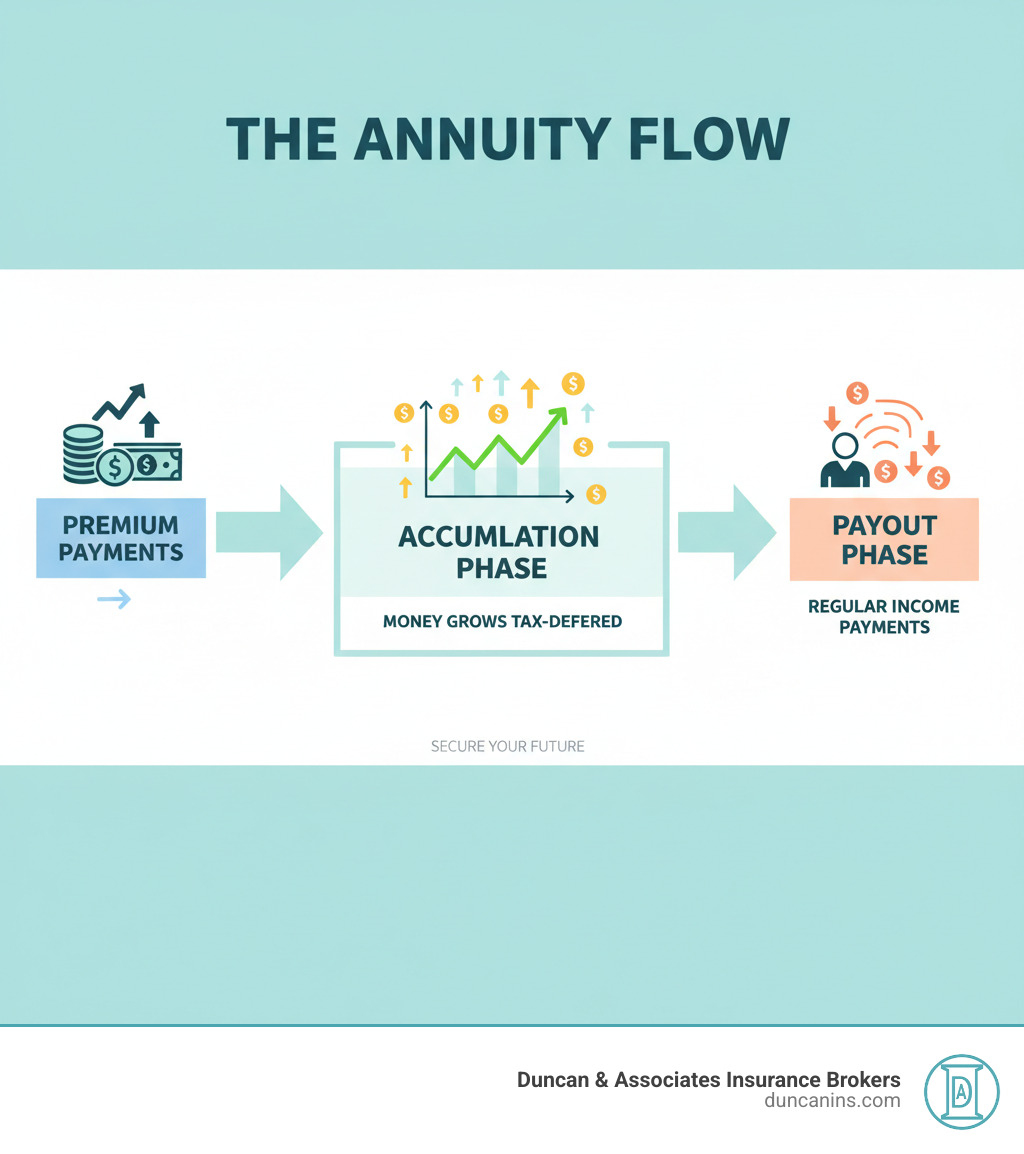
Annuities are contracts with an insurance company designed to provide guaranteed income, often for retirement. You pay premiums, your money grows tax-deferred, and then you receive regular payments.
Many people find annuities confusing due to jargon and complex options. However, they are valuable tools for securing retirement income you won’t outlive. The key is matching the right annuity to your age, risk tolerance, and financial goals. The right choice depends on your retirement timeline, investment style, and existing income sources.
I’m Heidi Duncan, owner of Duncan & Associates Insurance Brokers. I specialize in helping clients steer the different types of annuity to find solutions that fit their retirement plans. My goal is to simplify this topic so you can make an informed decision with confidence.
Types of annuity word guide:
The Core Concept: How Annuities Work
Think of an annuity as creating your own personal pension. You give an insurance company money now, and they promise to pay you back later, often with interest and for as long as you live.
Every annuity has two phases.
During the accumulation phase, your contributions grow tax-deferred. This means your earnings compound without being taxed annually, which can significantly boost growth over the long term.
The payout phase, or annuitization, begins when you convert your savings into a steady income stream. You receive regular payments for a set period or for life.

Understanding the parties involved helps clarify the process. The owner controls the contract, the annuitant is the person whose life expectancy determines payments, and the beneficiary receives any remaining funds upon the annuitant’s death.
The tax-deferral benefit is a primary reason people choose annuities. Letting your money grow without yearly tax bites means more money is working for you. You’ll pay ordinary income taxes on the earnings when you withdraw, but that may be during retirement when you’re in a lower tax bracket.
If you’re interested in other tax-advantaged ways to build retirement savings, our guide to Individual Retirement Accounts is worth a look.
Immediate vs. Deferred Annuities: The Payout Timeline
When you need income determines which annuity type is right for you.
Immediate annuities, or SPIAs (Single Premium Immediate Annuities), are for those needing income now. You make a lump-sum payment and start receiving income within a year, making them ideal for new retirees who want to turn savings into a reliable paycheck.
Deferred annuities are for long-term planning. You contribute funds that grow tax-deferred over many years. This is ideal for those still working who want to build a future income stream, as the longer growth period maximizes the power of tax deferral.

Payout Options: For a Period or For Life?
Once you decide when payments start, you must choose how long they last.
A life only option provides the highest possible monthly payment for your lifetime. Payments stop upon your death, with no remainder for beneficiaries. This maximizes income but carries the risk that an early death forfeits the remaining value.
Joint and survivor annuities provide income for two lifetimes, usually a couple’s. Payments are lower than a life-only option but continue as long as either person is alive, ensuring the surviving spouse has continued income.
Period certain options guarantee payments for a set number of years (e.g., 10 or 20). If you die before the period ends, your beneficiary receives the remaining payments. This balances lifetime income with leaving a legacy.
Each option involves trade-offs between higher payments and security for heirs. The right choice depends on your personal situation.
For broader planning around protecting your family’s financial future, our resources on Individual Life Insurance can complement your annuity strategy.
Exploring the Main Types of Annuity Based on Growth
How your money grows is a key differentiator among annuities, directly affecting your potential returns and risk level. The three main types of annuity based on growth are fixed, variable, and indexed. Fixed annuities offer the most safety, variable annuities have the most growth potential (and risk), and indexed annuities are a hybrid of the two.
Let’s look at how they compare side by side:
| Feature | Fixed Annuity | Variable Annuity | Indexed Annuity |
|---|---|---|---|
| Risk Level | Lowest | Highest | Moderate |
| Growth Potential | Predictable, steady, but limited | Potentially highest | Moderate |
| Principal Protection | Guaranteed | No guarantee | Protected from market loss |
| Market Exposure | None (guaranteed rate) | Direct (subaccount performance) | Indirect (index performance with caps/buffers) |
| Regulatory Body | State Insurance Dept. | SEC & State Insurance Dept. | State Insurance Dept. |
Each of these types of annuity serves a different purpose. Let’s dig into what makes each one tick.
Understanding Fixed Types of Annuity
Fixed annuities are the most straightforward option, offering predictability and safety. The insurance company gives you a specific interest rate for a set period. Your principal is completely protected from market downturns, and your money grows at that guaranteed rate. This makes them ideal for conservative investors who prioritize safety. The main challenge is inflation risk, as a fixed payment may lose purchasing power over time if inflation outpaces the annuity’s interest rate.
Variable Annuities: Potential for Higher Growth
Variable annuities allow you to participate directly in the financial markets. Your premiums are invested in subaccounts, similar to mutual funds, that hold stocks and bonds. This exposes you to market risk: if your investments do well, your annuity’s value grows, but if they perform poorly, you can lose principal. The trade-off for this risk is higher upside potential compared to fixed annuities. They suit investors with a higher risk tolerance and a longer time horizon. Because they are securities-based, they are regulated by the U.S. Securities and Exchange Commission (SEC) and state insurance departments.
Speaking of managing risk, businesses face similar decisions when protecting their most valuable assets–their key employees. If you’re interested in how companies steer this, check out our information on Key Person Life Insurance.
Indexed Annuities: A Hybrid Approach
Indexed annuities offer a hybrid approach, aiming for market-linked growth while protecting your principal. Your returns are linked to a market index, like the S&P 500. If the index rises, you earn interest. If it falls, your principal is protected from loss, often with a guaranteed minimum return of 0%. In exchange for this protection, your upside is limited by features like cap rates (a maximum potential gain) and participation rates (the percentage of the index’s gain credited to your account). This balanced approach appeals to those who want more growth potential than fixed annuities without the full risk of variable annuities, making them popular for people nearing retirement.
Key Considerations Before Choosing an Annuity

Choosing the right annuity depends entirely on your unique situation. At Duncan & Associates, we help clients steer this decision by focusing on their needs first.
Factors for Choosing Between Types of Annuity
- Age and time horizon are crucial. A younger person may prefer a deferred annuity for long-term growth, while a retiree might need an immediate annuity for instant income.
- Risk tolerance determines your choice. Fixed annuities suit conservative investors, variable annuities are for those comfortable with market risk, and indexed annuities offer a middle ground.
- Financial goals matter. Are you seeking lifetime income, wealth accumulation, or a legacy for heirs? Different annuities serve different purposes.
- Liquidity needs are a key consideration. Annuities are long-term products with penalties (surrender charges) for large, early withdrawals. They are not suitable for emergency funds.
- Other retirement income sources, like pensions or Social Security, should influence your decision. An annuity can supplement these sources to fill income gaps.
Understanding Annuity Fees and Charges
Annuities have fees that pay for the guarantees and benefits they provide. Understanding them is key.
- Surrender charges are fees for withdrawing more than the allowed amount during the initial years of the contract (the surrender period). These charges usually decline over time.
- Administrative fees cover the costs of maintaining your contract.
- Mortality and expense (M&E) fees, found in variable annuities, cover the insurer’s risks for features like lifetime income guarantees.
- Investment management fees apply to variable annuities and cover the management of the underlying subaccounts.
- Optional riders provide extra benefits, like improved death benefits or guaranteed lifetime withdrawals, for an additional annual fee.
Always ask for a complete breakdown of every fee before you commit. A good advisor will walk you through each one and explain what you’re getting in return.
How Annuities Are Taxed
The tax treatment of annuities is a key feature. The primary tax advantage is tax-deferred growth. Your earnings compound without being taxed annually, which can significantly increase your accumulation over time.
When you withdraw funds, the earnings are taxed as ordinary income. Your original contributions (the principal) are returned tax-free. The IRS also imposes a 10% penalty on withdrawals made before age 59 1/2, similar to other retirement accounts.
For regular annuity payments (annuitization), an exclusion ratio determines the taxable portion of each payment. Part of each payment is a tax-free return of principal, and the rest is taxable earnings. The insurance company provides this calculation.
For a deeper dive into annuities from an authoritative source, the U.S. Securities and Exchange Commission offers comprehensive guidance: Authoritative information on Annuities from the U.S. Securities and Exchange Commission.
Frequently Asked Questions about Annuity Types
We’ve helped many clients with their retirement planning, and certain questions come up often. Here are the answers to the most common ones.
What are the biggest risks associated with annuities?
It’s important to understand the risks associated with annuities:
- Illiquidity: Annuities are long-term products. Withdrawing large sums early incurs surrender charges, so they are not suitable for emergency funds.
- Market risk: With variable annuities, your account value can fall if the underlying investments perform poorly, meaning you can lose principal.
- Fees: Annuities have various fees (administrative, M&E, rider costs) that pay for their guarantees. These can be higher than fees for other investment products.
- Inflation risk: With fixed annuities, guaranteed payments may lose purchasing power over time if inflation rises.
Is my money safe if the insurance company fails?
Yes, there are multiple safety nets. Annuities are protected by state guaranty associations, which cover policyholders up to a certain limit (often $250,000) if an insurer fails. Coverage varies by state.
Choosing an insurer with high financial strength ratings from agencies like A.M. Best or Moody’s is also crucial. These ratings indicate a company’s ability to meet its financial obligations. Finally, insurers are subject to strict regulatory oversight and must maintain significant financial reserves to cover future claims.
While no investment is 100% risk-free, these protections make annuities a secure choice when purchased from a reputable, highly-rated company.
Are there any less common or specialized annuities?
Yes, several specialized types of annuity exist for specific needs:
- Multi-Year Guaranteed Annuities (MYGAs) offer a fixed interest rate for a specific term (e.g., 3-10 years), similar to a bank CD but with tax-deferred growth.
- Qualified Longevity Annuity Contracts (QLACs) are deferred annuities purchased with retirement funds that start paying out late in life (e.g., age 85) to protect against outliving your money. They can also help manage required minimum distributions (RMDs).
- Impaired life annuities may provide higher payouts to individuals with health conditions that reduce life expectancy, as the insurer anticipates a shorter payment period.
- Immediate needs annuities are designed to fund long-term care costs, providing a regular income stream to pay for care services.
Find Your Path to a Secure Retirement
We’ve explored the main types of annuity, from the guaranteed safety of fixed annuities to the growth potential of variable and indexed annuities. Annuities are powerful tools for providing guaranteed lifetime income, and their tax-deferred growth can significantly boost your retirement savings.
However, the “best” annuity is subjective. The right choice depends on your personal factors, including age, risk tolerance, and overall financial picture.
That’s where we come in. At Duncan & Associates Insurance Brokers, we prioritize understanding your needs to find the right solution. As an independent agency serving clients nationwide, we compare options from multiple carriers to find the best fit for your retirement goals.
Don’t let the complexity of annuities deter you. Our job is to simplify the process, explain the trade-offs, and help you make a confident decision. We’ve helped countless families in the Olympia area and beyond find their path to financial security.
Making insurance easy and 100% hassle-free isn’t just our tagline–it’s how we work. You shouldn’t have to become an insurance expert to protect your future. That’s our job.
Ready to explore how an annuity might fit into your retirement picture? We’d love to have that conversation with you.
