
Why Part-Time Employee Benefits Matter More Than Ever
In today’s competitive job market, part-time employee benefits are a critical tool for attracting and retaining talent. With over 27 million Americans working part-time, offering benefits is no longer just good for employees—it’s good for business. More than half of organizations now provide benefits to part-time staff, recognizing it builds loyalty and reduces turnover.
Key Part-Time Employee Benefits Overview:
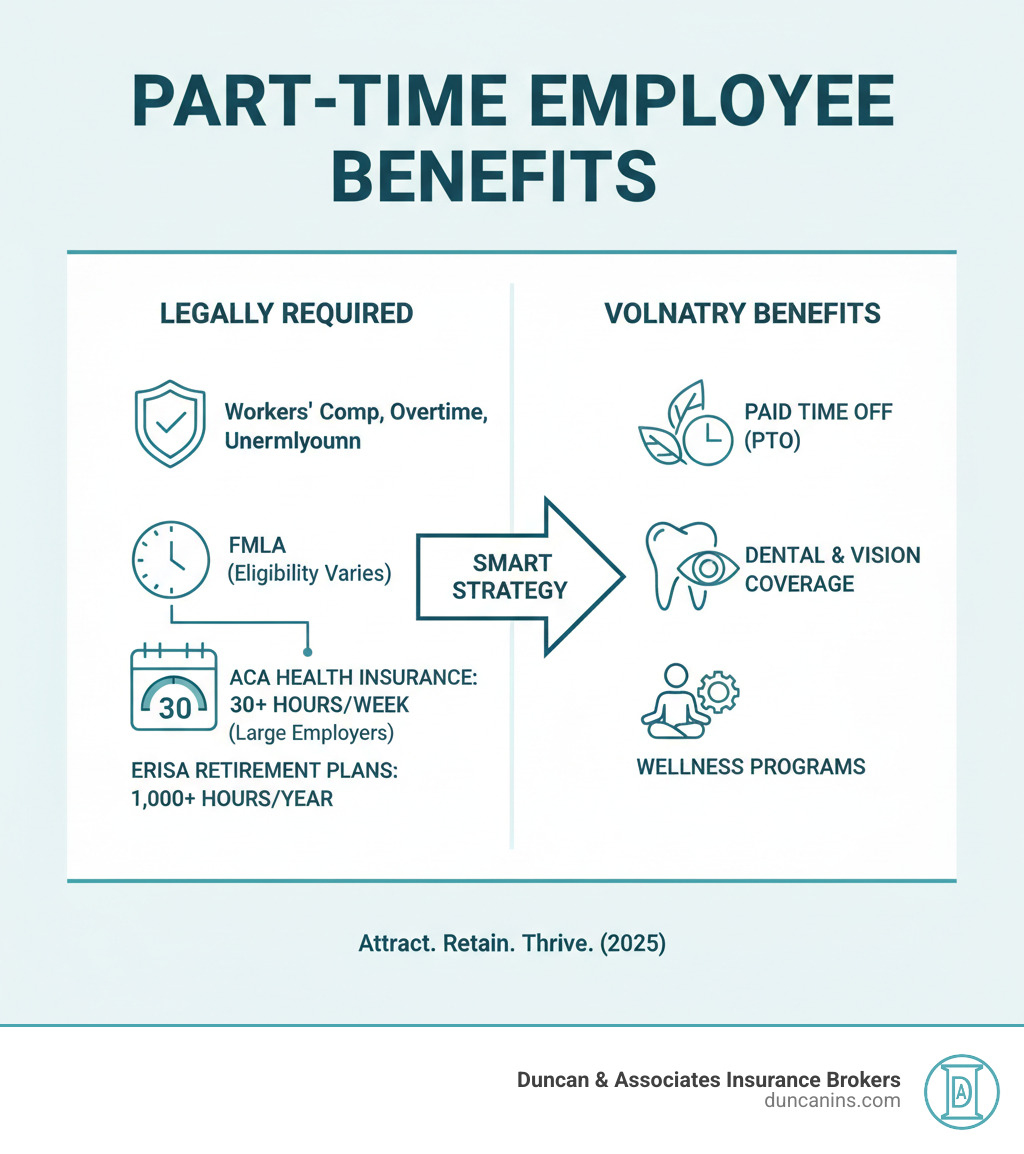
- Legally Required: Workers’ compensation, overtime, unemployment insurance, FMLA (if eligible)
- Common Voluntary Benefits: Health insurance, PTO, retirement plans, dental/vision
- Strategic Advantage: Reduced turnover, improved morale, wider talent pool
- Compliance Note: ACA requires health insurance for employees working 30+ hours at companies with 50+ employees.
Navigating the regulations can be complex. The IRS, Bureau of Labor Statistics, and recent SECURE Acts all have different definitions and rules, making compliance intricate. As the owner of Duncan & Associates Insurance Brokers, I’ve seen how the right benefits strategy can turn a part-time workforce into a competitive advantage. We’re here to help you steer these complexities and stay compliant.
What Is a Part-Time Employee?
Defining a “part-time employee” isn’t straightforward, as there’s no single federal definition. This ambiguity can complicate managing part-time employee benefits.
The Fair Labor Standards Act (FLSA), the primary federal wage and hour law, leaves the definition to employer discretion. This means you must create clear internal policies for classifying employees.
For guidance, different agencies offer benchmarks:
- The Bureau of Labor Statistics’ definition considers anyone working 1-34 hours per week as part-time.
- The IRS, for Affordable Care Act (ACA) purposes, defines full-time as an average of 30 hours per week or 130 hours per month.
This discrepancy is critical. An employee working 32 hours a week might be “part-time” by your company’s policy but is “full-time” under ACA rules, impacting your compliance obligations. The key is to understand these different thresholds and align your internal policies with federal guidelines to manage both business needs and legal requirements.
Legally Required Benefits for Part-Time Staff
While many part-time employee benefits are optional, some are legally required. Understanding these federal and state mandates is crucial for compliance and protecting your business.


Federal laws like the Fair Labor Standards Act (FLSA) mandate overtime pay. The Family and Medical Leave Act (FMLA) can also apply to part-time employees who meet the 1,250-hour rule (if you have 50+ employees).
At the state level, most require workers’ compensation and unemployment insurance for all employees. Additionally, many states now mandate paid sick leave and some require disability insurance, adding layers of complexity to compliance.
Overtime, Workers’ Comp, and Unemployment
Overtime pay: Under the FLSA, if a non-exempt part-time employee works over 40 hours in a workweek, you must pay them time and a half for the extra hours. Their part-time status is irrelevant when they exceed the 40-hour threshold.
Workers’ compensation: This coverage is mandatory in nearly all states and applies to all employees, including part-timers, from day one. It covers job-related injuries or illnesses and protects your business from related lawsuits.
Unemployment insurance: Eligibility for these state-run programs depends on an employee’s work history and earnings. Part-time employees who lose their job through no fault of their own may qualify. Check your state unemployment insurance programs for specific criteria.
State-Specific Mandates: Sick Leave and Disability
Many states have enacted their own laws requiring benefits beyond federal mandates.
Paid sick leave: Requirements vary widely. For example, New York requires employers to provide one hour of paid sick leave for every 30 hours worked. Michigan’s law applies to employees working over 25 hours per week. These laws ensure employees can take necessary sick time without losing income.
Short-term disability insurance: This is mandatory for all employees, including part-timers, in five states: California, Hawaii, New Jersey, New York, and Rhode Island. It provides income protection for non-work-related illnesses or injuries. We can help you steer these requirements with our Disability Insurance solutions.
Common Voluntary Benefits to Attract and Retain Talent
While legal requirements set the baseline, voluntary part-time employee benefits provide a competitive edge. In a tight job market, a thoughtful benefits package can be the deciding factor for top talent.

Leading companies demonstrate the value of this strategy. Starbucks, Costco, UPS, and Home Depot all offer robust benefits to their part-time staff, including health insurance, retirement plans, and even tuition reimbursement. These aren’t just perks; they are strategic investments that build loyalty and signal that every employee’s contribution is valued.
Health, Dental, and Vision Insurance
Health insurance is the crown jewel of benefits, with a 2022 poll showing 96% of people consider it important. While the ACA has mandates for some, offering health coverage even when not required is a powerful recruitment tool.
Many employers offer Group Health Insurance to part-time employees, with most insurance carriers setting eligibility at around 20 hours per week. This commitment can significantly reduce turnover.
Completing the package with Group Dental Insurance and Group Vision Insurance shows a commitment to your team’s total well-being. These highly valued benefits demonstrate you care about more than just on-the-job performance.
Paid Time Off (PTO) and Other Leave
Paid time off (PTO) is highly valued by part-time employees, who may have less of a financial safety net. While federal law doesn’t mandate it (beyond some state sick leave laws), offering voluntary PTO is a game-changer.
A common practice is a pro-rated approach: if full-time staff earn 80 hours of PTO, a part-timer working half the hours would earn 40. This is fair and simple to implement. Offering holiday pay, though not required, is another great way to boost morale.
Consider also offering Life and Accidental Death and Dismemberment Insurance. It’s an affordable benefit that provides significant peace of mind for employees and their families.
Financial and Professional Growth Benefits
Investing in your employees’ future sets you apart. Benefits that support financial and professional growth show you see their long-term potential.
- Tuition Reimbursement: Many companies offer up to $5,250 annually to part-time staff, creating a win-win by upskilling your workforce.
- Flexible Spending Account (FSA): An FSA like our Flexible Spending Account lets employees use pre-tax dollars for healthcare costs, putting money back in their pockets.
- Employee Assistance Plan (EAP): For a low cost, an Employee Assistance Plan provides confidential support for mental health, financial advice, and more.
- Wellness Perks: Stipends for wellness apps, flexible schedules, or commuter benefits are thoughtful touches that show you care about your employees as whole people.
Navigating Health Insurance and Retirement Plan Regulations
When it comes to part-time employee benefits, federal regulations can feel like navigating a complex maze. The Affordable Care Act (ACA) and the SECURE Acts create specific requirements that we need to understand for both compliance and designing an attractive benefits package. Getting these regulations right isn’t just about avoiding penalties—it’s about creating opportunities to attract and retain great talent.
| Benefit Type | Regulation | Key Requirement for Part-Time Employees |
|---|---|---|
| Health Insurance | Affordable Care Act (ACA) | Applicable Large Employers (50+ employees) must offer health insurance to employees working 30+ hours per week or 130+ hours per month |
| Retirement Plans | SECURE Act 1.0 & 2.0 | Employees working 1,000+ hours annually must be eligible for 401(k) plans; SECURE 2.0 reduces this to 500+ hours for long-term part-time employees (2+ years of service) |
The Affordable Care Act (ACA) and Part-Time Workers
The ACA has fundamentally changed how we think about part-time employee benefits, particularly when it comes to health insurance. If you’re an Applicable Large Employer (ALE)—meaning you have 50 or more full-time equivalent employees—the ACA creates specific responsibilities for your part-time staff.
Under the ACA’s full-time employee definition, anyone working an average of 30 or more hours per week is considered full-time, regardless of how your company internally classifies them. The Full-Time Equivalent (FTE) calculation combines hours from part-time staff to determine if you meet the 50-employee ALE threshold.
If you are an ALE, you must offer minimum essential coverage to employees working 30+ hours per week. This coverage must be affordable and provide minimum value, or you could face penalties. The good news? Many employers find that offering health benefits to part-time employees—even when not required—gives them a significant competitive advantage in attracting talent.
The SECURE Acts and Retirement Plan Eligibility
Retirement planning has traditionally been a full-time employee perk, but the SECURE Acts have opened new doors for part-time workers. These changes represent a significant shift in how we think about 401(k) benefits for our entire workforce.
Under the Employee Retirement Income Security Act (ERISA), the traditional rule required employees to work 1,000 hours annually to be eligible for retirement plan participation.
SECURE Act 1.0 and SECURE Act 2.0 created a game-changing provision for long-term part-time employees. Now, employees who work at least 500 hours annually for two consecutive years must be eligible for your 401(k) plan.
This means that a part-time employee working just 10 hours per week (about 520 hours annually) would qualify for retirement plan access after two years. By including them in retirement planning, we’re acknowledging their contribution and investing in their long-term financial security. Understanding these regulations might seem daunting, but the IRS provides an ALE Information Center to help you stay compliant.
Legally Required Benefits for Part-Time Staff
While many part-time employee benefits are discretionary, several protections apply regardless of hours. Knowing the federal and state minimums helps you stay compliant and avoid penalties.
At the federal level, the Fair Labor Standards Act (FLSA) governs overtime for non-exempt employees. The Family and Medical Leave Act (FMLA) may also apply to part-time workers who meet the 1,250-hour requirement within the past 12 months and work for an employer with 50+ employees.
- Overtime pay: Non-exempt employees must be paid time and a half for hours worked over 40 in a workweek. Part-time status does not change this requirement.
- Workers’ compensation: Generally required in nearly all states and applies to part-time employees from day one for job-related injuries or illnesses.
- Unemployment insurance: Part-time employees may qualify if they lose work through no fault of their own and meet state earnings and hours thresholds. Check your state program: State unemployment insurance programs.
State-Specific Mandates: Sick Leave and Disability
States and localities often add protections:
- Paid sick leave: Rules vary. For example, New York requires one hour of paid sick leave for every 30 hours worked. Michigan’s law applies to employees working over 25 hours per week.
- Short-term disability insurance: Mandatory in California, Hawaii, New Jersey, New York, and Rhode Island for non-work-related illnesses or injuries. Learn more about options through our Disability Insurance solutions.
Bottom line: Build clear policies that reflect both federal baselines and state or local mandates, and apply them consistently to part-time and full-time staff.
Common Voluntary Benefits to Attract and Retain Talent
Voluntary benefits are where you win in a tight labor market. Companies like Starbucks, Costco, UPS, and Home Depot offer part-time health coverage, retirement plans, tuition help, and more because it boosts loyalty, lowers turnover, and widens the talent pool.
Health, Dental, and Vision Insurance
Health insurance remains the most valued benefit. Even when not required by the ACA, extending Group Health Insurance to eligible part-time employees can be a differentiator. Many carriers allow eligibility at around 20 hours per week. Round out coverage with Group Dental Insurance and Group Vision Insurance to support overall well-being.
Paid Time Off (PTO) and Other Leave
Pro-rated PTO is simple and fair. If full-time employees receive 80 hours, a part-time employee working half the hours would receive 40. Holiday pay, while not required, is another morale booster. Consider also Life and Accidental Death and Dismemberment Insurance for affordable financial protection.
Financial and Professional Growth Benefits
- Tuition reimbursement: Offering up to $5,250 annually helps upskill your workforce and drive retention.
- Flexible Spending Account: Pre-tax dollars for healthcare and dependent care can stretch paychecks.
- Employee Assistance Plan: Low-cost, high-impact support for mental health, financial guidance, and more.
- Wellness perks: Stipends for wellness apps, commuter benefits, or flexible schedules show you value the whole person.
Keep eligibility rules clear, apply them consistently, and communicate benefits in plain language so part-time employees know what they can access and how.
Navigating Health Insurance and Retirement Plan Regulations
Federal rules around health insurance and retirement plans are central to part-time employee benefits. Get these right to stay compliant and design a package that works.
| Benefit Type | Regulation | Key Requirement for Part-Time Employees |
|---|---|---|
| Health Insurance | Affordable Care Act (ACA) | Employers with 50+ full-time equivalent employees must offer coverage to employees working 30+ hours/week or 130+ hours/month |
| Retirement Plans | SECURE Act 1.0 & 2.0 | Long-term part-time employees (500+ hours for 2 consecutive years) must be eligible for 401(k) participation |
The Affordable Care Act (ACA) and Part-Time Workers
If you are an Applicable Large Employer (ALE) with 50+ full-time equivalent employees, you must offer minimum essential coverage to those averaging 30+ hours per week. When calculating ALE status, include part-time hours using the Full-Time Equivalent (FTE) method: sum part-time hours each month and divide by 120. Coverage must be affordable and provide minimum value. See the IRS Applicable Large Employer (ALE) Information Center.
The SECURE Acts and Retirement Plan Eligibility
Historically, ERISA allowed plans to exclude employees working under 1,000 hours per year. The SECURE Acts changed that. Now, employees who work at least 500 hours in each of two consecutive years must be allowed to participate in your 401(k) plan. Employer matching for these long-term part-time employees is optional, but offering it can strengthen recruitment and retention.
Track hours carefully, align your policies with these thresholds, and communicate eligibility so part-time employees can plan ahead.
