
Why Your Income Is Your Most Valuable Asset
Long term disability insurance for self employed professionals is individual coverage that replaces 40-80% of your income if illness or injury prevents you from working for an extended period. Here’s what you need to know:
Key Features:
- Who needs it: Freelancers, consultants, contractors, and business owners without employer coverage
- What it covers: Your monthly income when you can’t work due to disability
- Typical cost: 1-3% of your annual income
- Coverage amount: Usually 60-80% of your pre-tax income
- Benefit period: Can last years or until retirement age
- Waiting period: Typically 30-90 days before benefits start
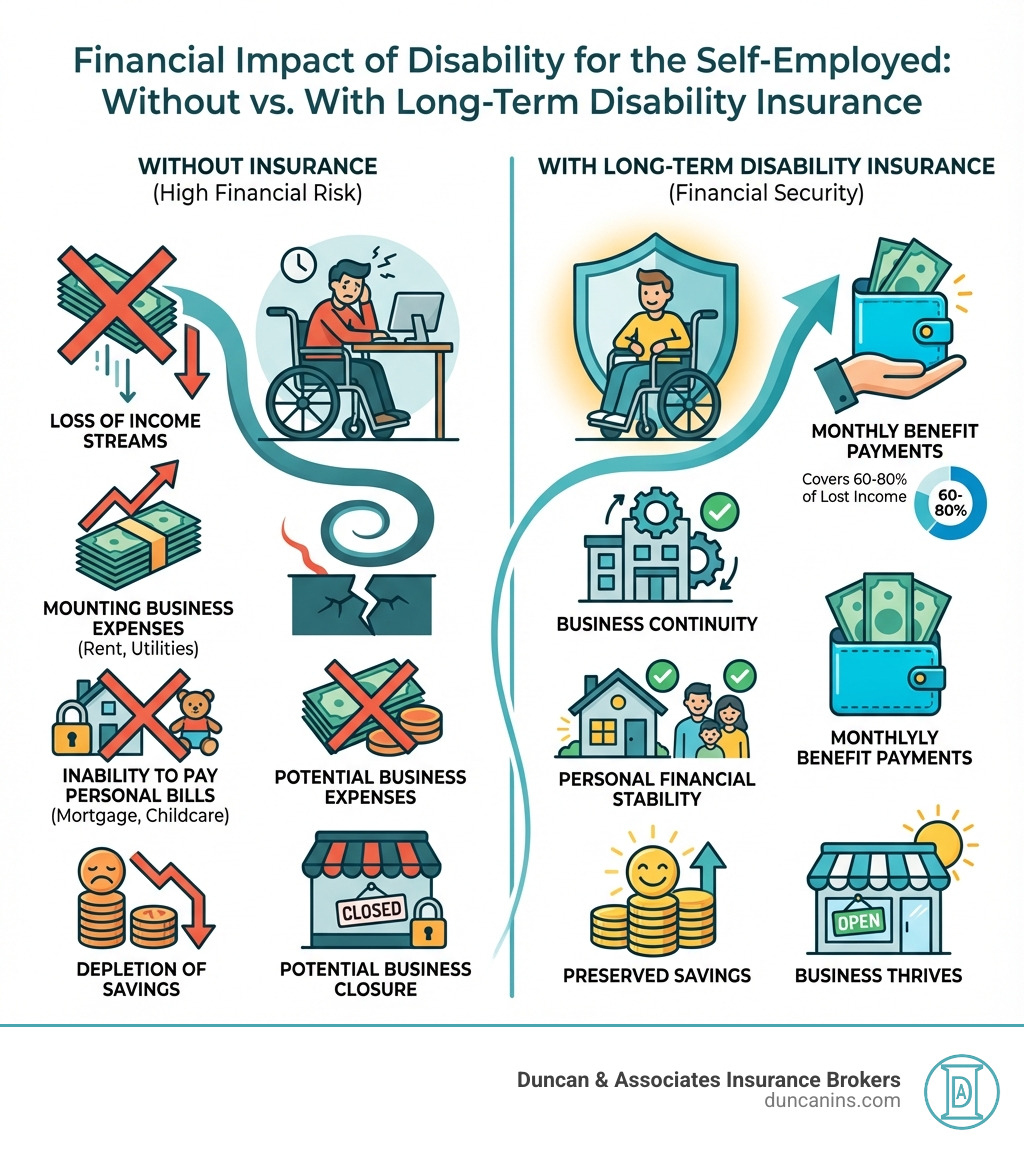
When you’re self-employed, you are your business. There’s no employer safety net, no paid sick leave, and no group disability plan to fall back on. If you can’t work, your income stops—but your bills don’t.
The statistics are sobering: one in four working adults will become disabled during their working years. For independent workers, this risk is especially dangerous because there may not be anyone qualified to step in and keep things running during your absence.
Unlike employees who might have group coverage through work, self-employed professionals must purchase individual policies on their own. This means navigating income verification requirements, understanding policy definitions, and choosing the right riders—all while running your business.
The good news? Long term disability insurance for self employed individuals offers more customization than group plans. You can tailor coverage to protect not just your personal income, but also your business expenses, loans, and overhead costs. The challenge is understanding what you actually need and finding the right policy at a price that fits your budget.
As Heidi Duncan, owner of Duncan & Associates Insurance Brokers, I’ve helped countless independent professionals secure long term disability insurance for self employed workers that protects both their income and their business. My team specializes in simplifying the insurance process for people who work for themselves, ensuring you get comprehensive coverage without the confusion.
Important long term disability insurance for self employed terms:
- short time disability insurance
- independent contractor workers compensation insurance
- Part-time employee benefits
How Long Term Disability Insurance for Self Employed Individuals Works
Your ability to earn an income is your most valuable asset. Long term disability insurance for self employed individuals acts as a financial safety net, replacing a significant portion of your income if a serious illness or injury prevents you from working.

The mechanics of a policy typically involve several key components:
- Premiums: The regular payment you make to keep your policy active. Cost is influenced by many factors.
- Benefit Amount: The monthly sum you receive if you become disabled, usually 40% to 80% of your pre-disability income.
- Elimination Period (or Waiting Period): The time between your disability’s start and when benefits begin, typically 30 to 180 days. It’s like a time-based deductible.
- Benefit Period: How long you receive benefits for a claim, ranging from a few years to retirement age, depending on your policy.
Income verification is critical for the self-employed due to fluctuating income. Insurers require proof of earnings, typically several years of tax returns (like Schedule C) and business financials, to determine an accurate benefit amount. While more involved than for W2 employees, it’s a necessary step to protect your unique financial structure.
Understanding these policy mechanics is a crucial part of securing the importance of insurance for independent contractors.
Understanding Policy Types: Individual Coverage & Association Plans
As a self-employed professional, your primary option for disability coverage will be an individual long-term disability (LTD) policy. Unlike group plans offered by employers, an individual policy is owned by you, not your business. This offers significant advantages:
- Portability: Your policy stays with you, regardless of career changes. If you switch from being a freelance consultant to a small business owner, your coverage moves with you.
- Customization: Individual policies are highly customizable. You can tailor the benefit amount, benefit period, elimination period, and add various riders to suit your specific needs and financial goals. This flexibility is a major benefit for self-employed individuals whose needs might evolve.
Some professional associations offer group disability plans to members. These may have competitive rates but often lack the customization of an individual policy. While worth exploring, a robust individual policy is typically the cornerstone of protection for the self-employed.
It’s also important to distinguish between short-term and long-term disability. Short-term disability insurance covers temporary disabilities for a few weeks to six months. In contrast, long term disability insurance for self employed individuals is for illnesses or injuries lasting months or years. While short-term coverage is valuable, long-term coverage is essential for sustained financial security.
The Critical Difference: ‘Own-Occupation’ vs. ‘Any-Occupation’
One of the most crucial distinctions in long term disability insurance for self employed policies is the definition of “disability.” This definition dictates the circumstances under which you can receive benefits. The two main types are ‘own-occupation’ and ‘any-occupation.’
- ‘Own-Occupation’ Definition: This is generally considered the gold standard, especially for self-employed professionals. An ‘own-occupation’ policy pays benefits if you cannot perform the substantial and material duties of your specific occupation, even if you could perform a different job. For example, if you’re a freelance graphic designer who develops a hand injury preventing you from using a mouse or drawing, an ‘own-occupation’ policy would pay out, even if you could still work as a cashier. This is vital for specialized professions where your unique skills define your earning capacity.
- ‘Any-Occupation’ Definition: This definition is much more restrictive. It only pays benefits if you cannot perform the duties of any occupation for which you are reasonably suited by education, training, or experience. Using the graphic designer example, if you could still work as a cashier, an ‘any-occupation’ policy might deny your claim, arguing you are capable of some work. These policies are typically less expensive but offer significantly less protection.

Many policies start with an ‘own-occupation’ definition for a certain period (e.g., the first 24 months) and then switch to ‘any-occupation.’ However, some policies offer “true own-occupation” or “extended own-occupation” riders that maintain the more favorable definition for the entire benefit period.
This distinction is vital for the self-employed, whose occupations are often highly specific. For example, if a surgeon can no longer operate but could teach, an ‘own-occupation’ policy would protect their surgical income, whereas an ‘any-occupation’ policy might deny benefits. Ensuring your policy protects your ability to perform our unique work is paramount.
Additionally, consider “partial disability” or “residual disability” clauses. These allow you to receive a partial benefit if you can work but not at your full capacity or earning potential. This flexibility is incredibly valuable for self-employed individuals who might be able to ease back into work or whose income might be reduced but not completely eliminated due by a lingering condition.
Customizing Your Coverage: Key Features and Riders
A key advantage of individual long term disability insurance for self employed professionals is customization. You can shape your policy to fit your unique circumstances and provide robust protection.

When selecting a policy, we focus on key features like the renewability clause, which is critical for long-term security:
- Non-Cancellable and Guaranteed Renewable: This is the most comprehensive type of policy. As long as you pay your premiums on time, the insurance company cannot cancel your policy, increase your premiums, or reduce your benefits.
- Guaranteed Renewable: With this type, the insurer cannot cancel your policy or reduce your benefits, but they can increase your premiums if they do so for an entire class of policyholders.
- Conditionally Renewable: This is the least secure option, allowing the insurer to renew or cancel the policy based on certain conditions.
For a comprehensive understanding of these policies, explore our guide on long-term disability insurance.
Here is a list of essential riders we often recommend for self-employed individuals:
Essential Riders for the Self-Employed
Riders are optional additions that tailor your policy to your needs as an independent worker:
- Residual Disability Rider: Crucial for the self-employed, this provides a partial benefit if a disability causes income loss (e.g., from working part-time). It recognizes that disability isn’t always all-or-nothing.
- Cost-of-Living Adjustment (COLA) Rider: This rider increases your monthly benefits over time (e.g., 3-6% annually) to keep pace with inflation, maintaining your purchasing power during a long-term disability.
- Future Increase Option (FIO) Rider: This allows you to increase your benefit amount as your income grows, without a new medical exam. It’s ideal for growing businesses.
- Retirement Protection Rider: If you become disabled, this rider continues contributions to a retirement account, protecting your long-term financial security beyond income replacement.
- Student Loan Rider: For those still paying off student loans, this rider can provide additional funds specifically to cover those payments during a period of disability.
Protecting Your Business, Not Just Your Paycheck
A personal disability can jeopardize your business. We look beyond income replacement to solutions that protect your enterprise:
- Business Overhead Expense (BOE) Insurance: If you become disabled, BOE insurance reimburses fixed business expenses like rent, utilities, and non-owner salaries. It keeps your business afloat while you recover without using your personal disability benefits.
- Key Person Insurance: If your business relies on a key person (including yourself), this insurance provides funds to offset lost revenue or cover replacement costs if that person becomes disabled.
- Disability Buy-Sell Agreements: For businesses with multiple owners, this agreement, funded by disability insurance, provides capital for remaining owners to buy out a disabled partner’s share, ensuring a smooth transition.
These specialized coverages are crucial for maintaining business stability and are distinct from independent contractor workers compensation insurance, which covers work-related injuries. While workers’ compensation is for on-the-job incidents, these disability policies protect against off-the-job illnesses and injuries that could still cripple your business.
Calculating Your Needs, Costs, and Tax Implications
Determining how much long term disability insurance for self employed individuals need involves replacing enough income to meet obligations without over-insuring.
A good rule of thumb is to aim for coverage that replaces 60% to 80% of your pre-tax income. Why not 100%? Because insurers want to ensure you have a financial incentive to return to work, and also because benefits paid from individually-owned policies are typically tax-free (more on that below). You’ll need to estimate your monthly personal and fixed business expenses.
The cost of your disability insurance will depend on several factors:
- Age: Younger individuals generally pay less.
- Health: Your current health status and medical history play a significant role.
- Occupation Risk: Your profession’s inherent risk level impacts premiums.
- Benefit Amount and Period: Higher monthly benefits and longer benefit periods increase premiums.
- Elimination Period: A shorter waiting period means higher premiums than a longer one.
- Riders: Adding optional riders will increase the cost but improve your coverage.
Expect to pay between 1% to 3% of your annual income for a comprehensive policy. For a $100,000 income, that’s $1,000 to $3,000 per year. While this may seem like a lot, it provides peace of mind against losing your entire income stream.
Tax Rules for Long Term Disability Insurance for Self Employed Workers
Understanding the tax implications of long term disability insurance for self employed individuals is crucial for maximizing your benefits.
The general rule is: if you pay your premiums with after-tax dollars, your disability benefits will be received tax-free. This is the most common and recommended approach for individual policies.
If you deduct premiums as a business expense (possible for some business-specific policies like BOE), then benefits are taxable income.
For self-employed individuals operating under different business structures:
- Sole Proprietors/Independent Contractors: Premiums for individual policies are generally not tax-deductible, so benefits are tax-free.
- S-Corporations, LLPs, and LLCs: If the business pays and deducts premiums for an owner-employee, benefits are taxable. To ensure tax-free benefits, owners should pay premiums personally with after-tax dollars.
- C-Corporations: C-corps can deduct premiums for employees. If the C-corp pays and deducts an owner’s premiums, benefits are taxable. For tax-free benefits, the owner should pay premiums with after-tax dollars.
Most self-employed individuals prioritize tax-free benefits, which means paying premiums with after-tax dollars. Always consult a tax professional for your specific situation and its impact on your Disability Insurance for the Self-Employed strategy.
Navigating Your Options: From Application to Claim
Applying for long term disability insurance for self employed individuals can seem daunting, but we guide you through it. The process ensures the insurer understands your risk profile and income to offer appropriate coverage.
The application process typically involves these steps, where we guide you from start to finish:
- Initial Inquiry & Quote Comparison: We start by helping you calculate your coverage needs. Then, as independent brokers, we gather quotes from top-rated carriers to find your best options.
- Formal Application: We assist you in completing the detailed application, ensuring all personal, medical, and financial information is correctly provided.
- Phone Interview & Medical Exam: We prepare you for the insurer’s phone interview and help schedule the required medical exam. This usually involves a paramedical professional taking basic measurements and samples.
- Financial Documentation: This is crucial for the self-employed. We’ll guide you on submitting the necessary proof of income, typically 2-3 years of tax returns (Schedule C, K-1s, etc.) and business financials.
- Underwriting: The insurer reviews all information to assess your risk and determine final approval and rates. This can take several weeks.
- Policy Issuance & Acceptance: Once approved, we’ll explain your policy details, including any riders and conditions, before you sign and make your first premium payment to activate your coverage.
This comprehensive process ensures that when you need to make a claim, the insurer has all the necessary information to process it efficiently. For more general information about this type of coverage, check out our page on disability insurance.
Understanding Public Disability Benefits and Their Limitations
Many self-employed individuals wonder about public disability benefits, primarily Social Security Disability Insurance (SSDI). While SSDI can provide a safety net, it’s crucial to understand its limitations and why private long term disability insurance for self employed individuals is still essential.
- Eligibility: To be eligible for SSDI, you must pay self-employment taxes to earn enough work credits. Unlike W2 employees, you are responsible for these payments, as outlined by the Social Security Administration.
- Strict Definition of Disability: SSDI uses a strict ‘any-occupation’ definition of disability: you must be unable to perform any substantial gainful activity for at least 12 months. This is much harder to meet than the ‘own-occupation’ definition in many private policies.
- Waiting Periods: SSDI has a mandatory five-month waiting period before benefits begin.
- Benefit Amounts: SSDI benefits are modest and may not cover all living or business expenses, as they are designed to provide only a basic income.
- Application Process: The application process is lengthy and complex, with approvals often taking months or years.
A few states offer short-term disability programs, but for most, relying on public benefits leaves significant coverage gaps. Private long term disability insurance for self employed individuals offers earlier payouts, higher benefits, a better definition of disability, and a streamlined claims process, making it indispensable.
Frequently Asked Questions about Self-Employed Disability Insurance
We hear a lot of questions from independent professionals about protecting their income. Here are some of the most common ones:
What should I look for in a disability insurance provider?
When choosing a provider for your long term disability insurance for self employed policy, we recommend looking for:
- Financial Strength Ratings: Opt for companies with high ratings from independent agencies like A.M. Best, Fitch, Moody’s, and S&P. This indicates their ability to pay claims long-term.
- Robust ‘Own-Occupation’ Definitions: Prioritize policies that offer the strongest ‘own-occupation’ definition, ideally for the entire benefit period, especially if your profession is highly specialized.
- Comprehensive Rider Availability: Ensure the provider offers a wide range of riders that are valuable to self-employed individuals, such as Residual Disability, Future Increase Option, COLA, and Business Overhead Expense.
- Customization Options: The more flexible the policy, the better it can adapt to your evolving needs.
- Reputation and Customer Service: Check reviews and discuss with us to understand their claims processing reputation and customer support.
How much disability coverage do I really need?
There’s no one-size-fits-all answer, but we aim to cover your essential expenses. We’ll help you calculate:
- Your Monthly Living Expenses: This includes your mortgage/rent, utilities, groceries, transportation, insurance premiums, and other household costs.
- Your Fixed Business Overhead: If you own a business, consider rent, utilities, salaries for non-owner employees, and other operational costs that continue even if you can’t work.
Generally, we recommend covering 60% to 80% of your pre-tax income. This percentage is a sweet spot that typically provides enough to live on (especially since benefits are often tax-free) without making the premiums prohibitively expensive. Don’t underinsure; a severe long-term disability is a significant financial event.
What’s the biggest mistake to avoid when buying disability insurance?
The biggest mistake we see self-employed individuals make is waiting too long to get coverage, or not getting it at all. The younger and healthier you are, the more affordable and comprehensive your policy will be. Once you have health issues, it becomes much harder and more expensive to qualify.
Other common mistakes include:
- Choosing ‘Any-Occupation’ to Save Money: While cheaper, this definition offers significantly less protection and can lead to denied claims if you’re capable of any work, even if it’s not your specialized profession.
- Not Buying Enough Coverage: Underinsuring can leave you in a financial bind during a disability, forcing you to deplete savings or go into debt.
- Forgetting Business-Specific Riders: Forgetting to add Business Overhead Expense or a Disability Buy-Sell rider can jeopardize your entire business, not just your personal income.
- Not Working with an Independent Advisor: Trying to steer the complex world of disability insurance alone means you might miss out on the best rates or critical policy features for your unique self-employed situation.
Get Expert Guidance for Your Independent Career
As we’ve explored, securing long term disability insurance for self employed individuals isn’t just a good idea—it’s a critical foundation for your financial stability and business continuity. Your income is your most valuable asset, and protecting your ability to earn it should be a top priority. Without it, a sudden illness or injury could derail not only your personal finances but also everything you’ve worked so hard to build in your independent career.
At Duncan & Associates Insurance Brokers, we understand the unique challenges and opportunities that come with being self-employed. We pride ourselves on making insurance easy and 100% hassle-free. As independent insurance brokers, we work for you, not for a single insurance company. This means we can shop around, compare policies from multiple top-rated carriers, and provide you with a choice of options custom to your specific needs, budget, and business structure.
Our expert, client-first service ensures that you get comprehensive coverage without the confusion. We’ll help you steer the complexities of income verification, explain the nuances of ‘own-occupation’ versus ‘any-occupation’ definitions, and recommend the essential riders that will truly protect your livelihood. Don’t go it alone when it comes to safeguarding your future.
Let us be your trusted advisor in securing the robust long-term disability protection you deserve. Get help with your employee benefits and personal income protection today.
