
Protecting Your Palette and Your Profits
Liability insurance for painting contractors protects your business from financial losses when third parties claim you caused bodily injury, property damage, or other covered incidents. Here’s what painting contractors need to know:
Essential Coverage Types:
- General Liability Insurance – Covers third-party injury and property damage claims
- Workers’ Compensation – Required by law in most states if you have employees
- Commercial Auto Insurance – Protects business vehicles and liability while driving
- Inland Marine Insurance – Covers tools and equipment theft or damage
Typical Costs:
- Small painting businesses: $400-$700 annually for general liability
- Average monthly cost: Around $68 for general liability coverage
- Workers’ compensation: $3.48-$8.36 per $100 of employee payroll
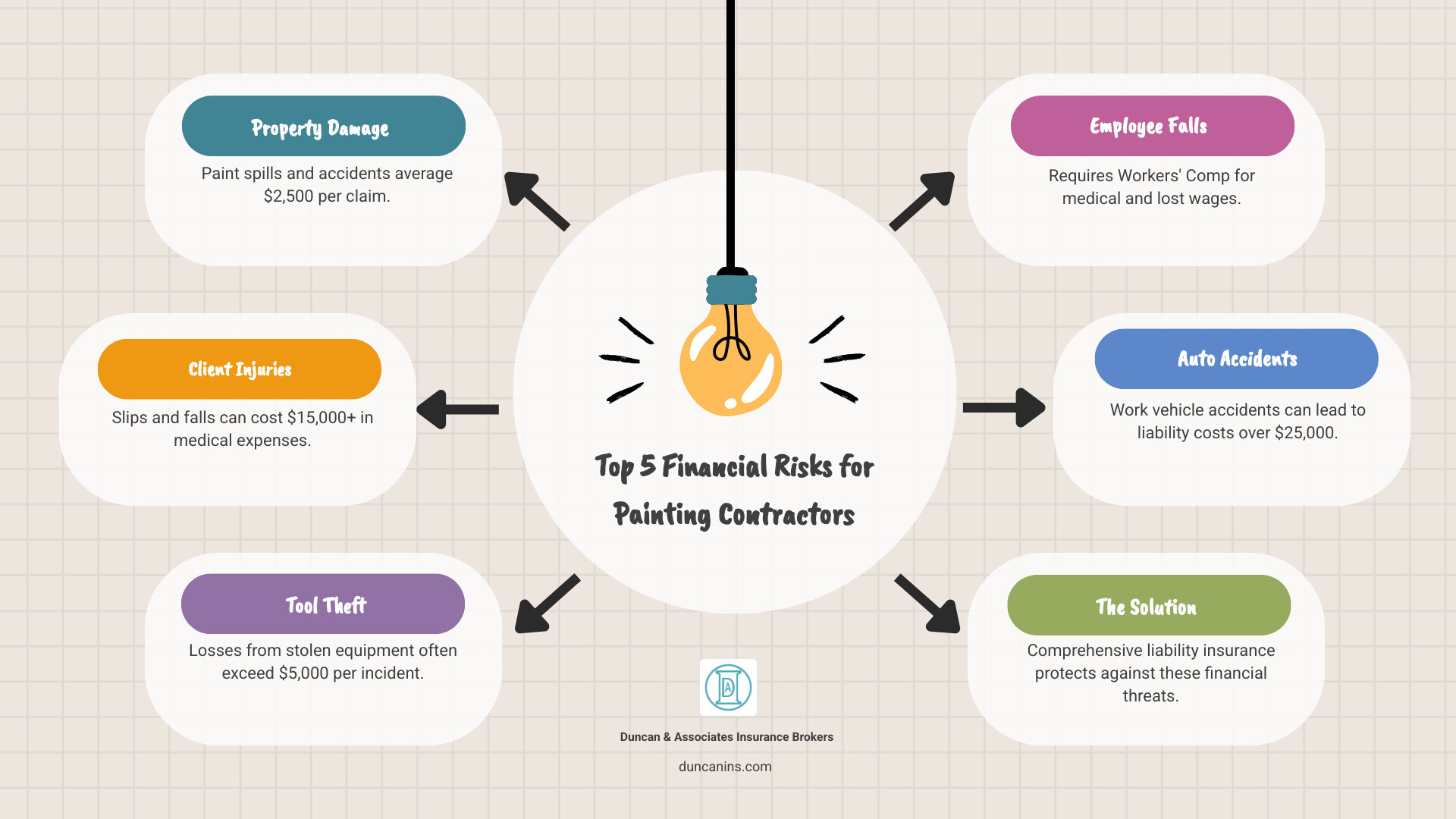
Imagine a can of paint getting knocked over and ruining a client’s new hardwood floors. Without proper insurance, that accident could cost thousands out of your pocket. With over 365,000 people working as painters in the U.S., the industry faces daily risks that can turn profitable jobs into financial disasters.
Accidents are a reality of the job, whether you’re on a ladder, using a sprayer, or moving through a client’s home. A spilled can of paint can ruin an expensive carpet, a misplaced drop cloth can cause a client to fall, and malfunctioning equipment can lead to serious property damage. These risks are part of the business, and every painting contractor must be prepared.
As Heidi Duncan, owner of Duncan & Associates Insurance Brokers, I’ve helped countless painting contractors steer the complexities of liability insurance for painting contractors and protect their businesses from unexpected claims. My team and I understand the unique risks painters face and work to simplify the insurance process so you can focus on what you do best.
The Foundation: What is General Liability Insurance?
Think of liability insurance for painting contractors as your business’s financial bodyguard. General liability insurance, sometimes called Commercial General Liability (CGL), protects your painting business when someone claims you’ve caused them harm or damaged their property. It’s the foundation that keeps your business standing when accidents happen.

Imagine you accidentally knock over a paint can, damaging your client’s expensive rug. Without general liability coverage, the replacement cost comes straight from your pocket. With it, your insurance steps in to handle the cost.

General liability covers three main areas that painting contractors face daily. Bodily injury protection kicks in if someone gets hurt because of your work, like a client slipping on a wet spot. Property damage coverage handles situations like paint overspray hitting a neighbor’s car or a ladder falling through a window. Personal and advertising injury covers less obvious risks, such as accidentally using a competitor’s slogan in your marketing.
Here’s where it gets really important for painters: completed operations coverage. This protects you from claims that arise after you’ve finished the job. For example, if an exterior paint job you completed last month starts peeling and causes someone to slip on the chips, completed operations coverage can respond to these delayed incidents.
Even small incidents can lead to major financial headaches. Our General Liability Insurance page dives deeper into the specific protections your painting business needs.
Why is liability insurance for painting contractors a must-have?
Simply put, liability insurance for painting contractors is as essential as your brushes and drop cloths. Here’s why.
Client requirements top the list. Most general contractors and property managers won’t let you on their property without a Certificate of Insurance (COI). No insurance often means no work.
Legal defense costs can be crippling. Even if a claim is baseless, defending your business in court is expensive. General liability insurance covers these legal fees, protecting your finances while you defend your reputation.
Peace of mind is invaluable. Knowing you’re protected lets you focus on delivering quality work instead of worrying about what might go wrong. This confidence helps you perform better.
Business growth is enabled by proper protection. Insured contractors can confidently take on bigger projects and work with higher-end clients. Insurance doesn’t just protect what you have—it helps you build your future.
We’ve documented countless real-world examples where contractors without proper coverage faced financial ruin. You can read these stories on our page about Real-Life Claims Show Why You Need Contractor’s Insurance.
Common Claims Scenarios for Painters
Every painter has horror stories, but some scenarios are especially common. Here are the claims we see most often.
Paint overspray on cars is a frequent and expensive claim. Wind can carry paint mist onto nearby vehicles, and the cost to remove it from multiple cars can easily exceed $20,000.
Client slips on a drop cloth sounds minor, but medical bills add up fast. A homeowner who slips and breaks their wrist could face $8,000-$12,000 in medical expenses, plus lost wages.
Ladder falls and damages property can turn a routine job into a nightmare. An unsecured ladder crashing through a bay window can quickly lead to $5,000-$8,000 in repair and replacement costs.
Slander or libel claims can happen unexpectedly. An employee makes negative comments about a client that damage their reputation, leading to a lawsuit. These personal injury claims fall under your general liability coverage.
The bottom line is that accidents can happen to even the most careful contractors. That’s why liability insurance for painting contractors is essential for staying in business.
Expanding Your Coverage: Other Essential Insurance for Painters
Think of liability insurance for painting contractors as the foundation of your protection. While general liability is crucial, a true safety net requires a complete toolbox of coverage. You wouldn’t show up to a job with just one paintbrush, and your insurance should be just as comprehensive.
Let me walk you through other essential policies that work with your general liability coverage. Each one addresses specific risks of the painting business. We help our clients Steer Contractor’s Insurance Coverage Types with Ease to find the right combination for their unique situation.
Workers’ Compensation Insurance
Painting is a physically demanding job where injuries can happen. There were 2.7 million nonfatal workplace injuries and illnesses in 2020, and construction trades like painting carry high risks.
This is where workers’ compensation insurance becomes your lifeline. If an employee gets hurt on the job, this policy covers their medical expenses and provides lost wages while they recover. For example, if a painter falls from a ladder, workers’ comp pays for the hospital visit and a portion of their salary while they heal.
In most states, workers’ compensation is a legal requirement if you have employees. Skipping it can lead to heavy fines. It also protects your business from lawsuits, as injured workers covered by workers’ comp typically cannot sue their employer for the injury.
You can learn more on our Workers Compensation Insurance page.
Commercial Auto Insurance
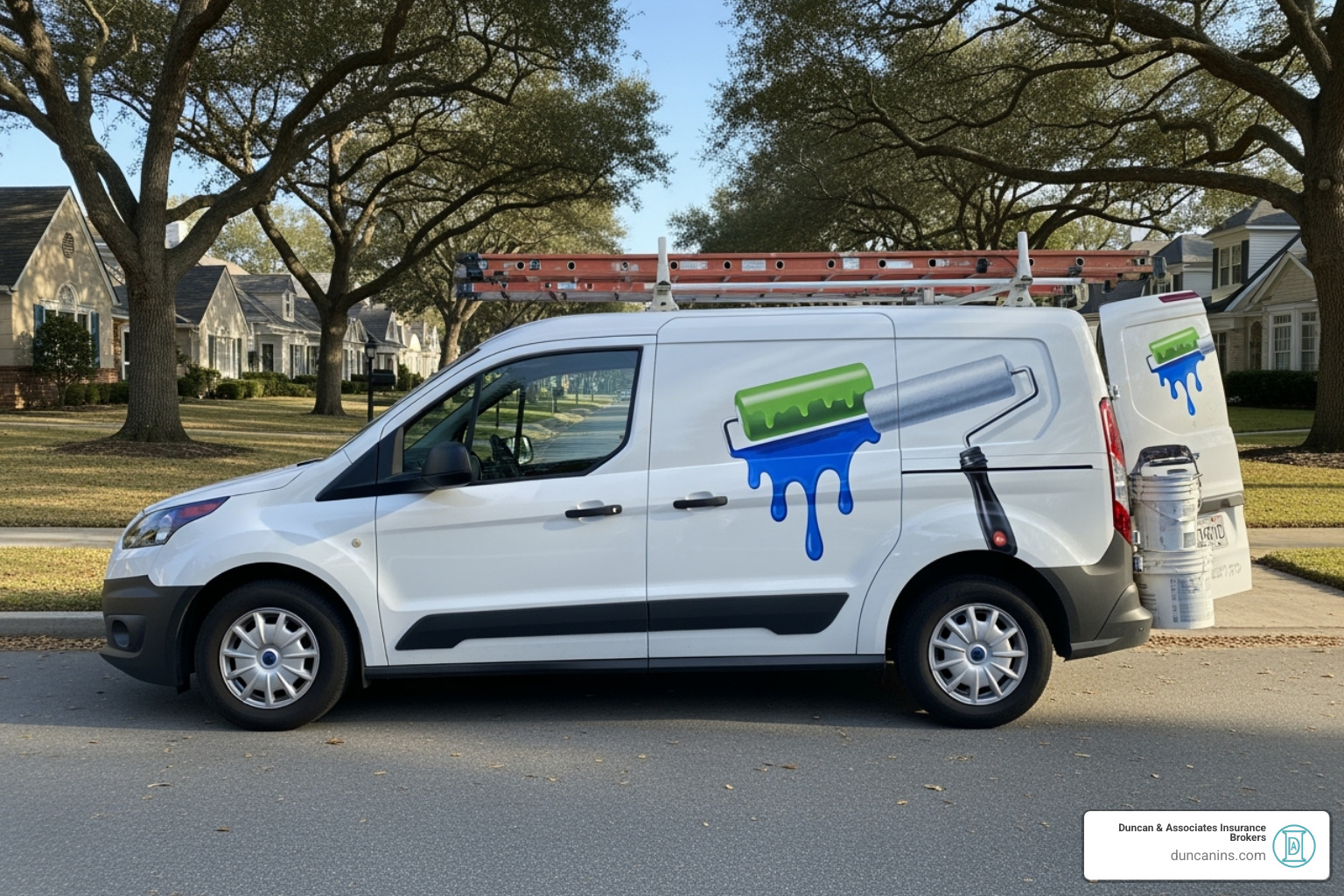
Your work van is a mobile headquarters, carrying thousands of dollars in equipment. Whether it’s an old pickup or a new van, it needs proper coverage.
A common mistake is relying on personal auto insurance, which won’t cover business use. If you have an accident while driving to a job site, your personal policy could deny the claim. Commercial auto insurance is designed for this purpose.
This policy covers liability for accidents you or your employees cause while driving for work, plus physical damage to your business vehicles. If you back into a client’s car or a tree falls on your truck, commercial auto insurance handles the repairs and any medical bills.
Learn more about protecting your mobile assets on our Business Auto Insurance page.
Inland Marine Insurance (Contractor’s Equipment)
Your tools—sprayers, ladders, and scaffolding—are a major investment. Without them, you can’t work.
Your tools are constantly on the move, making them a prime target for theft. Inland Marine Insurance, also known as contractor’s equipment coverage, is designed for this risk. Unlike standard property insurance, this policy follows your tools wherever they go.
It provides coverage for theft from a job site, your van, or temporary storage. It also includes transit and off-site protection, so your equipment is covered while moving between jobs. It’s like a security guard for your most valuable assets.
Check out our Inland Marine Insurance page to see how this coverage can protect your livelihood.
Business Owner’s Policy (BOP)
For smaller painting operations, a Business Owner’s Policy (BOP) is an excellent option. A BOP is like a combo meal—it bundles key coverages at a better price.
A BOP combines general liability and commercial property insurance into one package, often at a lower cost than buying them separately. This gives you liability protection plus coverage for your physical business property, like your office, shop, or stored inventory.
The cost savings can be significant for small businesses. Plus, managing one policy is simpler than juggling several. If you have a workshop or office, a BOP is a smart choice, as it also covers damage from fire, theft, and other perils.
Explore if a BOP is right for you on our Business Owners Insurance page.
Understanding the Cost of Liability Insurance for Painting Contractors
One of the first questions painters ask is, “What will this cost?” The truth is, liability insurance for painting contractors doesn’t have a fixed price. The cost is customized based on your unique business factors.
Understanding these cost drivers helps you budget effectively and find ways to keep premiums reasonable. For a deeper look at how insurance costs are calculated, check out our Comprehensive Look at Contractor’s Insurance Cost Elements.

Key Factors That Influence Your Premiums
Several ingredients determine your final premium. Here’s what insurers look at:
- Business revenue: Higher annual revenue means more work and greater exposure to potential claims, leading to higher premiums.
- Number of employees: More workers increase the chances of both workplace injuries and third-party incidents, affecting your general liability and workers’ comp costs.
- Claims history: A clean record helps keep costs down. Frequent or costly claims will cause premiums to rise. New businesses may pay more initially but can earn lower rates after a few years of claims-free operation.
- Location and state laws: Rates vary by state and even city. Local regulations, cost of living, and medical expenses all influence premium calculations.
- Type of painting work: The risk profile for interior residential touch-ups is very different from sandblasting an industrial facility. High-risk work means higher premiums.
What are the typical costs for liability insurance for painting contractors?
While every business is unique, these general ranges can help you budget:
General liability insurance for small operations with revenue under $50,000 typically costs between $400 and $700 annually. For most painters, the average monthly cost is around $68.
As your business grows, so do the premiums. A business with $150,000 in revenue and one employee might pay $1,200 – $2,000 annually for general liability, while a larger operation with $1 million in revenue and five employees could see premiums from $5,800 – $10,100. As a rule of thumb, general liability premiums often fall between 0.6% and 1.5% of your annual revenue.
Workers’ compensation insurance is based on payroll. Painters can expect to pay between $3.48 and $8.36 per $100 of payroll. For an employee earning $50,000, your workers’ comp might cost around $240 per month.
Other essential coverages add to your total cost. Inland marine insurance for tools typically runs $50 to $300 annually. Commercial auto insurance ranges from $1,500 to $3,050 per vehicle annually. Professional liability (E&O) insurance is often affordable at $50 to $500 per year.
| Business Size (Annual Revenue) | Employees | Estimated Annual General Liability Premium Range |
|---|---|---|
| Under $50,000 | 1 (owner) | $400 – $700 |
| $150,000 | 1 | $1,200 – $2,000 |
| $500,000 | 3 | $3,400 – $5,200 |
| $1,000,000 | 5 | $5,800 – $10,100 |
Insurance is an investment in protecting your business. The cost of an uninsured claim is far greater than any premium. There are smart ways to manage these costs, and our guide on Effective Tips for Cutting Contractor’s Insurance Costs Today offers practical strategies.
Smart Strokes: Risk Management and Legal Compliance
Insurance is just one tool. Combining it with smart risk management and legal compliance protects your business and can lower your premiums over time. We’re here to help you Safeguard Your Business with Contractor’s Insurance through every step.
The painting industry has enough variables to worry about. You shouldn’t have to stress about whether you’re properly protected or compliant with regulations.
Recommended Liability Limits and Correct Classification
For liability insurance for painting contractors, most policies start with standard limits: $1 million per occurrence (for a single incident) and $2 million aggregate (total for the policy year).
These limits are usually sufficient for residential and light commercial work. For larger projects, you might need more protection. That’s where Commercial Umbrella Insurance comes in. An umbrella policy provides extra liability coverage that kicks in after your primary limits are exhausted, protecting you from catastrophic claims.
Correct classification is also crucial. Insurance companies use codes to categorize your business risk (painters are often class code 5474). An incorrect code can lead to premium hikes or coverage gaps. Be upfront about the full scope of your work, from interior residential to exterior industrial jobs.
The Value of a Safety Program and Subcontractor Insurance
A documented safety program is like a good primer—it improves everything. Besides protecting your team, it can significantly lower your insurance premiums by improving your experience modification rate (e-mod), which is a score based on your workers’ compensation claims history.
Reducing accidents protects your people and your bottom line. Simple measures like ladder training, requiring protective equipment, and safe chemical handling make a huge difference.
Verifying subcontractor insurance is also critical. If your sub isn’t insured and causes an accident, you could be held liable. Always collect a current Certificate of Insurance (COI) from every subcontractor before they begin work.
Ensure they have adequate general liability and workers’ compensation, and require them to name your business as an “additional insured” on their policy. This provides another layer of protection. We explain this in more detail in our guide on Clarifying Subcontractor Needs for Contractor’s Insurance Today.
Frequently Asked Questions about Painters Insurance
When it comes to liability insurance for painting contractors, we hear the same questions time and again. Let me share the answers that matter most to your business.
Do I need insurance if I’m a self-employed painter with no employees?
Absolutely, yes. Even as a one-person operation, general liability insurance is essential.
As a sole proprietor, there’s no legal separation between your business and personal finances. If you cause damage, your personal assets are on the line. Without insurance, a $10,000 claim against you could come from your personal savings or home equity.
Furthermore, most clients won’t hire you without proof of insurance. General contractors and savvy homeowners will ask for a Certificate of Insurance to protect their own interests. Accidents don’t discriminate based on business size; the same risks exist whether you have one employee or fifty.
What is a Certificate of Insurance (COI) and why do I need one?
Think of a Certificate of Insurance (COI) as your business’s insurance ID card. It’s a one-page document that proves you have the required coverage.
This document is your ticket to getting hired. Many clients, general contractors, and property managers require a COI before work can begin. It’s a standard part of most contracts.
The COI summarizes your coverage, policy limits, and expiration dates. It gives clients confidence that you are a responsible professional.
Getting a COI is quick and easy. Once your policy is active, your insurance provider can generate one for you. If you’re ready to get covered, we can help you get a quote and your COI efficiently.
Does general liability cover mistakes in my work, like using the wrong color?
This is a common point of confusion. General liability insurance does not cover professional mistakes like using the wrong paint color or other workmanship issues.
General liability is for third-party bodily injury and property damage that occurs during your work. If you knock over a vase or your ladder damages a car, that’s a general liability claim. If you have to repaint a room because you used the wrong color, that cost is not covered.
Professional mistakes fall under Errors & Omissions (E&O) insurance, also known as professional liability. This policy covers claims that you made a mistake in your professional service. While not always required for painters, it’s worth considering if you offer design consulting or work on high-end projects where a professional error could be costly.
You can learn more about this specialized coverage on our Errors and Omissions Liability Insurance page.
Get the Right Coverage for Your Painting Business
After exploring the ins and outs of liability insurance for painting contractors, you now understand that protecting your business isn’t about finding one magic policy. It’s about creating a comprehensive safety net that matches your specific needs as a painting professional.
Think of it like preparing for a big job. You wouldn’t show up with just one brush, right? You bring the right tools for each task. Insurance works the same way. General liability handles those everyday “oops” moments when paint goes where it shouldn’t. Workers’ compensation takes care of your team when ladders and gravity don’t get along. Commercial auto protects your mobile workshop on wheels. And inland marine keeps your valuable tools covered whether they’re at the job site or in transit.
The key is finding coverage that fits your business like a well-worn pair of work gloves – comfortable, protective, and designed for how you actually work. Maybe you’re a solo painter who mainly does residential interiors. Your needs will look different from a crew that tackles commercial exteriors with spray equipment.
At Duncan & Associates Insurance Brokers, we get it. We’ve been helping painting contractors across the nation for years, and we know that every business has its own story. That’s why we don’t believe in cookie-cutter solutions. We take the time to understand your operation, your concerns, and your budget. Then we work to craft an insurance plan that actually makes sense for your business.
Insurance doesn’t have to be complicated or stressful. Our goal is to make the whole process 100% hassle-free so you can focus on what you do best – creating beautiful spaces with your paintbrush and expertise.
Don’t let uncertainty about coverage keep you up at night or prevent you from taking on that next big project. The peace of mind that comes from proper insurance protection is worth its weight in premium paint.
Ready to protect your business the right way? Contact us for a comprehensive review of your contractor insurance needs and let’s work together to build the perfect coverage plan for your painting business. Your future self will thank you for taking this important step today.
