
Why High Net Worth Individuals Are Prime Targets for Liability Claims
How much umbrella insurance do i need high net worth individuals typically need? Here’s the quick answer:
- Minimum Coverage: At least equal to your total net worth
- Recommended Starting Point: $3-5 million for those with $1M+ in assets
- High Earners: $3-5 million for those earning $300K+ annually to protect future income
- Cost: Approximately $150-500/year for $1M coverage, with each additional million adding $75-100/year
- Coverage Calculation: Total your assets (real estate, investments, savings) + future earning potential – existing policy limits = umbrella insurance need
One distracted moment or unfortunate accident can lead to a multi-million dollar lawsuit that standard insurance policies won’t cover. This makes umbrella insurance an essential component of high-net-worth financial planning.
The uncomfortable truth is that wealthy individuals are attractive targets for liability claims due to a perception of “deep pockets.” When your assets include significant home equity, investments, and future earnings, you have a lot to lose.
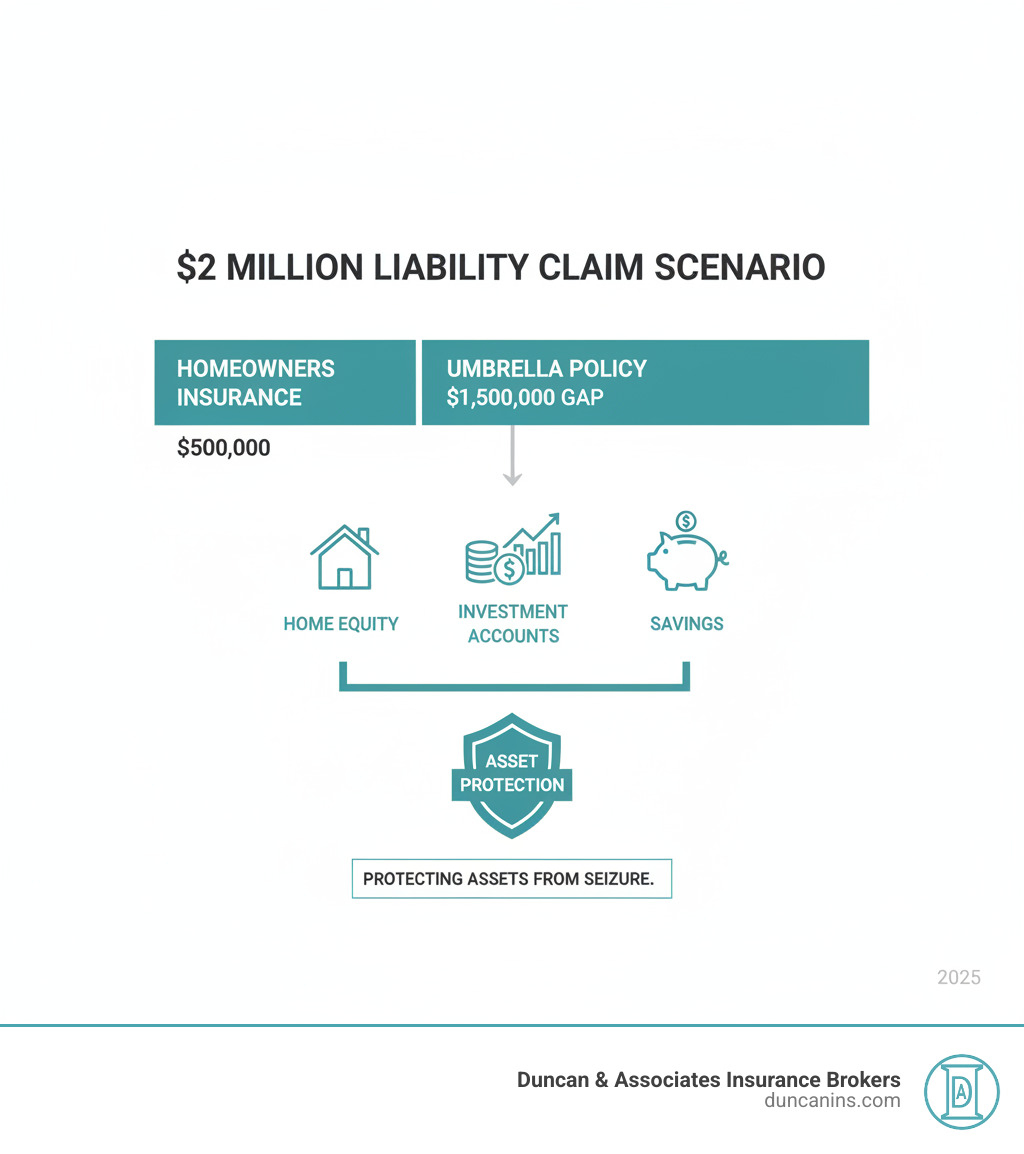
A $1.5 million settlement from a car accident can quickly exhaust a standard $500,000 auto policy limit. When a judgment exceeds your primary coverage, the remaining amount must come from your personal assets: your savings, your retirement accounts, and your home equity.
Umbrella insurance acts as your financial safety net, providing an additional layer of protection when your primary policies run out. It covers the gap between what your standard policies pay and what you’re legally obligated to pay, protecting your assets from being seized and your future wages from being garnished.
As Heidi Duncan, owner of Duncan & Associates Insurance Brokers, I specialize in helping high-net-worth clients determine the right amount of umbrella insurance for their unique asset profiles and risk exposures. We craft personalized insurance strategies that go beyond standard coverage to protect significant wealth.
Understanding Umbrella Insurance: Your Ultimate Financial Safety Net
Think of your standard home and auto policies as a raincoat—useful for everyday showers. Umbrella insurance is the large, sturdy umbrella you need for a major storm. It’s an extra layer of personal liability coverage that steps in when your regular policy limits are exhausted.
For high-net-worth individuals wondering how much umbrella insurance do i need high net worth to be protected, this coverage is essential. Your substantial assets make you an attractive lawsuit target, and a single large claim could jeopardize your financial future. An umbrella policy provides peace of mind that one unexpected event won’t destroy everything you’ve worked for.
For a deeper dive into how this coverage protects your financial future, check out our comprehensive guide on Umbrella Insurance.


What Umbrella Insurance Covers (and What It Doesn’t)
Umbrella insurance offers broad protection that often extends beyond your primary policies.
What It Covers:
- Bodily Injury & Property Damage Liability: Covers costs that exceed your primary policy limits if you’re found liable for an accident that injures someone or damages their property.
- Personal Injury Claims: This is a key benefit for HNWIs. It protects against claims for slander, libel, defamation, false arrest, and invasion of privacy—risks often excluded from standard policies.
- Landlord Liability: Adds another layer of protection beyond your basic landlord insurance for incidents occurring at your rental properties.
- Legal Defense Costs: Pays for attorney fees, court costs, and other legal expenses associated with a covered claim, even if the lawsuit against you is baseless.
- Worldwide Coverage: Many policies protect you from liability claims for incidents that happen anywhere in the world.
What It Doesn’t Cover:
- Your own injuries or property damage: This is liability-only coverage for harm to others.
- Business-related liability: You need a separate commercial umbrella policy for business activities.
- Intentional or criminal acts: Insurance does not cover deliberate wrongdoing.
- Other exclusions: Policies typically exclude events like war, nuclear incidents, and the transmission of communicable diseases.
Umbrella vs. Excess Liability Insurance
While these terms sound similar, they offer different types of protection.
Excess liability insurance simply increases the dollar limit of a single underlying policy, like your auto insurance. It provides more of the same coverage you already have.
Umbrella insurance is much broader. It provides a single, higher limit over all your personal liability policies (auto, home, boat, etc.). Crucially, it can also cover claims that your primary policies don’t, such as libel or slander, after a small deductible known as a Self-Insured Retention (SIR).
For HNWIs with diverse risks, umbrella insurance offers more comprehensive and flexible protection.
| Feature | Umbrella Insurance | Excess Liability Insurance |
|---|---|---|
| Coverage Scope | Broad; extends over multiple underlying policies (auto, home, boat, etc.) | Narrow; increases limits for a single, specific underlying policy |
| Additional Coverages | Can cover claims not typically included in primary policies (e.g., slander, libel, false arrest, worldwide coverage) | Generally does not add new types of coverage, only increases existing limits |
| Deductible Equivalent | Often has a “self-insured retention” (SIR) for claims not covered by underlying policies | No separate deductible; follows the underlying policy’s deductible |
| Flexibility | More flexible, filling potential gaps across various personal liabilities | Less flexible, focused solely on increasing limits of one policy |
To understand how each type of coverage might work for your specific situation, visit our detailed pages on Umbrella Insurance and Excess Liability Insurance.
How Much Umbrella Insurance Do I Need as a High Net Worth Individual?
The most common question I hear is: how much umbrella insurance do i need high net worth individuals to be truly protected? The answer depends on three factors: your assets, your future earnings, and your lifestyle.
The general rule is to secure coverage at least equal to your net worth. However, for HNWIs, I recommend exceeding that baseline. A lawsuit can target not only your current assets but also your future income and family’s financial security.

Let’s walk through how to calculate the right coverage for you.
Step 1: Calculate Your Net Worth and Future Earnings
First, get a clear picture of your total financial exposure. This includes more than just your bank balance.
- Assets: Tally your home equity, savings and investment accounts (stocks, bonds, mutual funds), vehicle equity, and valuable possessions like jewelry or art collections.
- Future Income Potential: This is critical. Courts can garnish future wages. If you earn $300,000 or more annually, advisors often recommend $3 million to $5 million in coverage to protect decades of future earnings, even if your current net worth is lower.
Add up your assets and subtract your liabilities (mortgages, loans) to determine your net worth. While certain retirement accounts like 401(k)s are generally protected from lawsuits under federal ERISA regulations, they are still part of your complete financial picture. For more details, the U.S. Department of Labor provides helpful FAQs about retirement plans and ERISA protections.
Step 2: Evaluate Your Personal Risk Profile
Your lifestyle and assets determine your level of risk. Certain factors significantly increase your chances of facing a major lawsuit:
- High-Risk Home Features: Swimming pools and trampolines are considered “attractive nuisances.”
- Teenage Drivers: Young drivers have higher accident rates, which can lead to claims far exceeding standard auto policy limits.
- Multiple Properties: Each home or rental property you own is another potential source of liability.
- Public Profile: Serving on boards or having a high public profile can make you more vulnerable to lawsuits, including defamation claims.
- Recreational Assets: Boats, jet skis, and RVs come with their own liability risks.
- Other Factors: Owning certain dog breeds or frequently hosting parties can also increase your risk.
Each of these factors multiplies your exposure, making a personalized risk assessment crucial.
Step 3: Review Your Underlying Policy Requirements
Umbrella insurance sits on top of your existing policies, which must meet certain minimum liability limits before an umbrella can be issued.
- Auto Insurance: Typically requires limits of at least $250,000 per person and $500,000 per accident (250/500).
- Home Insurance: Usually requires at least $300,000 in personal liability coverage, with $500,000 preferred.
If your current policies don’t meet these minimums, they will need to be increased. You should also be aware of the Self-Insured Retention (SIR), which is a small deductible (often $250-$500) that applies to claims covered by the umbrella but not by an underlying policy.
The Insurance Information Institute provides helpful context on these requirements.
The Cost of Peace of Mind: Umbrella Premiums and Coverage Tiers
What surprises most people about umbrella insurance is its affordability. For a modest annual premium—often less than a monthly cable bill—you can secure millions in protection against a financially devastating lawsuit. This makes it one of the most cost-effective components of financial planning.

Bundling your umbrella policy with your existing home and auto insurance almost always leads to discounts, making this essential protection even more accessible.
Typical Coverage Limits and Annual Costs for HNWIs
Umbrella policies are sold in increments of $1 million. For HNWIs, this coverage is a fundamental part of protecting your wealth.
- $1 Million Policy: This baseline coverage typically costs between $150 and $500 per year.
- $3 to $5 Million Policy: Recommended for those with a seven-figure net worth or an annual income over $300,000, this tier protects both current assets and future earning potential.
- $10 Million+ Policies: For ultra-high-net-worth individuals, policies of $10 million or more are available, with annual premiums often starting around $1,500 to $2,500.
The cost to add more protection is surprisingly low. After the first million, each additional million in coverage typically adds just $75 to $100 to your annual premium.
Factors That Influence Your Premium
Several factors determine your specific premium:
- Coverage Amount: Higher limits mean higher premiums, though the incremental cost is small.
- Personal Risk Profile: Your premium is affected by risk factors like teenage drivers, swimming pools, certain dog breeds, and multiple properties.
- Driving Records: A household of drivers with clean records will have lower premiums than one with multiple accidents or violations.
- Geographic Location: Premiums vary by state and even zip code due to differences in local litigation trends.
- Self-Insured Retention (SIR): Choosing a higher SIR (deductible) can lower your premium.
- Bundling: Combining your umbrella policy with your auto and Home Insurance is one of the easiest ways to get a discount.
Frequently Asked Questions about HNW Umbrella Insurance
When working with high-net-worth clients, I often address the same pressing questions about asset protection. Here are the answers to the most common concerns.
What are the consequences of being underinsured?
Being underinsured is one of the greatest financial risks a high-net-worth individual can take. If a legal judgment exceeds your policy limits, you could face:
- Asset Seizure: Your home, vacation properties, investment accounts, and other valuable assets could be liquidated to satisfy the judgment.
- Future Wage Garnishment: Courts can order a portion of your future income to be taken until the debt is paid, potentially costing you millions over time.
- Depletion of Savings: Retirement and other savings accounts can be drained to cover the shortfall.
- Severe Financial and Emotional Stress: The process can cause profound disruption to your family’s stability and lifestyle.
The annual cost of an adequate umbrella policy is a tiny fraction of what you stand to lose in a single unprotected judgment.
When should I reassess my umbrella coverage?
Your insurance coverage should evolve with your life. At a minimum, review your coverage annually. However, certain life events should trigger an immediate reassessment:
- A significant increase in your assets or income.
- Marriage or welcoming a new child to your family.
- A teenager getting their driver’s license.
- Purchasing a new high-risk asset, such as a boat, a second home, an RV, or a rental property.
- Starting a new business or accepting a position on a board of directors.
Does umbrella insurance cover lawsuits for libel or slander?
Yes, and this is one of its most valuable and underappreciated features. Umbrella policies cover what’s known as “personal injury” claims, which are often excluded from standard policies. This includes:
- Defamation (both libel and slander)
- False arrest or imprisonment
- Malicious prosecution
- Invasion of privacy
In our hyper-connected world, a careless social media post, a negative online review, or a misspoken comment can easily lead to an expensive lawsuit. Your umbrella policy steps in to cover both your legal defense costs and any resulting judgments or settlements, providing a critical safety net that your homeowners or auto insurance does not.
Conclusion: Securing Your Legacy with the Right Coverage
For high-net-worth individuals, umbrella insurance is not an optional add-on; it’s an essential part of your financial foundation. In an unpredictable world, a single accident can put a lifetime of work at risk. Standard policies are simply not enough when a lawsuit reaches seven figures. The cost of umbrella insurance is minimal when you consider the assets it protects.
So, how much umbrella insurance do i need high net worth?
There is no magic number. The answer to how much umbrella insurance do i need high net worth individuals require is a personalized calculation. Your coverage should be enough to protect your total net worth plus a cushion for future earnings, adjusted for your unique lifestyle risks.
For most individuals with a net worth over $1 million, we recommend starting with at least $3 million in coverage. Many clients with substantial assets opt for $5 million, $10 million, or even higher limits. The good news is that each additional million dollars of protection costs remarkably little—often just $75 to $100 more per year.
This is a personalized strategy, not a one-size-fits-all product.
How much umbrella insurance do i need high net worth: Getting Expert Guidance
Navigating insurance for high-net-worth individuals is complex. That’s where working with an independent broker makes all the difference. At Duncan & Associates Insurance Brokers, we work for you, not the insurance carriers. We compare options from multiple providers to craft a comprehensive protection strategy that is easy and 100% hassle-free.
Our client-first service ensures you get the right coverage to protect everything you’ve built. We’ve helped countless HNW families find the optimal balance between comprehensive protection and cost-effectiveness.
Your legacy is too important to leave vulnerable. Protect your assets with a comprehensive High Net Worth Insurance review with Duncan & Associates Insurance Brokers today. Let’s have a conversation to ensure you have the peace of mind you deserve.
