
Why FMCSA Insurance Requirements Matter for Your Commercial Operation
FMCSA insurance requirements are the federal minimum levels of financial responsibility that motor carriers must maintain to operate legally in interstate commerce. These mandates protect the public and ensure carriers can cover costs from accidents.
Quick Answer: Minimum FMCSA Insurance Requirements
| Vehicle/Operation Type | Minimum Coverage |
|---|---|
| Vehicles under 10,001 lbs (non-hazardous) | $300,000 |
| Vehicles over 10,001 lbs (non-hazardous) | $750,000 |
| Vehicles hauling motor vehicles/equipment | $1,000,000 |
| Hazardous materials | $5,000,000 |
| Passenger vehicles (15 or fewer) | $1,500,000 |
| Passenger vehicles (16 or more) | $5,000,000 |
The Federal Motor Carrier Safety Administration (FMCSA) aims to reduce crashes involving commercial vehicles. A key part of this mission is ensuring every interstate motor carrier can financially cover potential damages. Without the correct insurance filings, your Motor Carrier (MC) number remains inactive, preventing you from legally hauling freight or passengers.
Whether you’re starting a trucking company or just trying to understand forms like BMC-91 or MCS-90, the regulatory maze can feel overwhelming. It’s easy to get lost in the details of state vs. federal minimums, cargo vs. liability coverage, and filing deadlines.
I’m Heidi Duncan, owner of Duncan & Associates Insurance Brokers, and I’ve spent years helping commercial carriers steer FMCSA insurance requirements and secure the coverage they need to operate legally and confidently. Whether you’re launching your first truck or managing a growing fleet, understanding these requirements is the foundation of protecting your business and staying on the road.
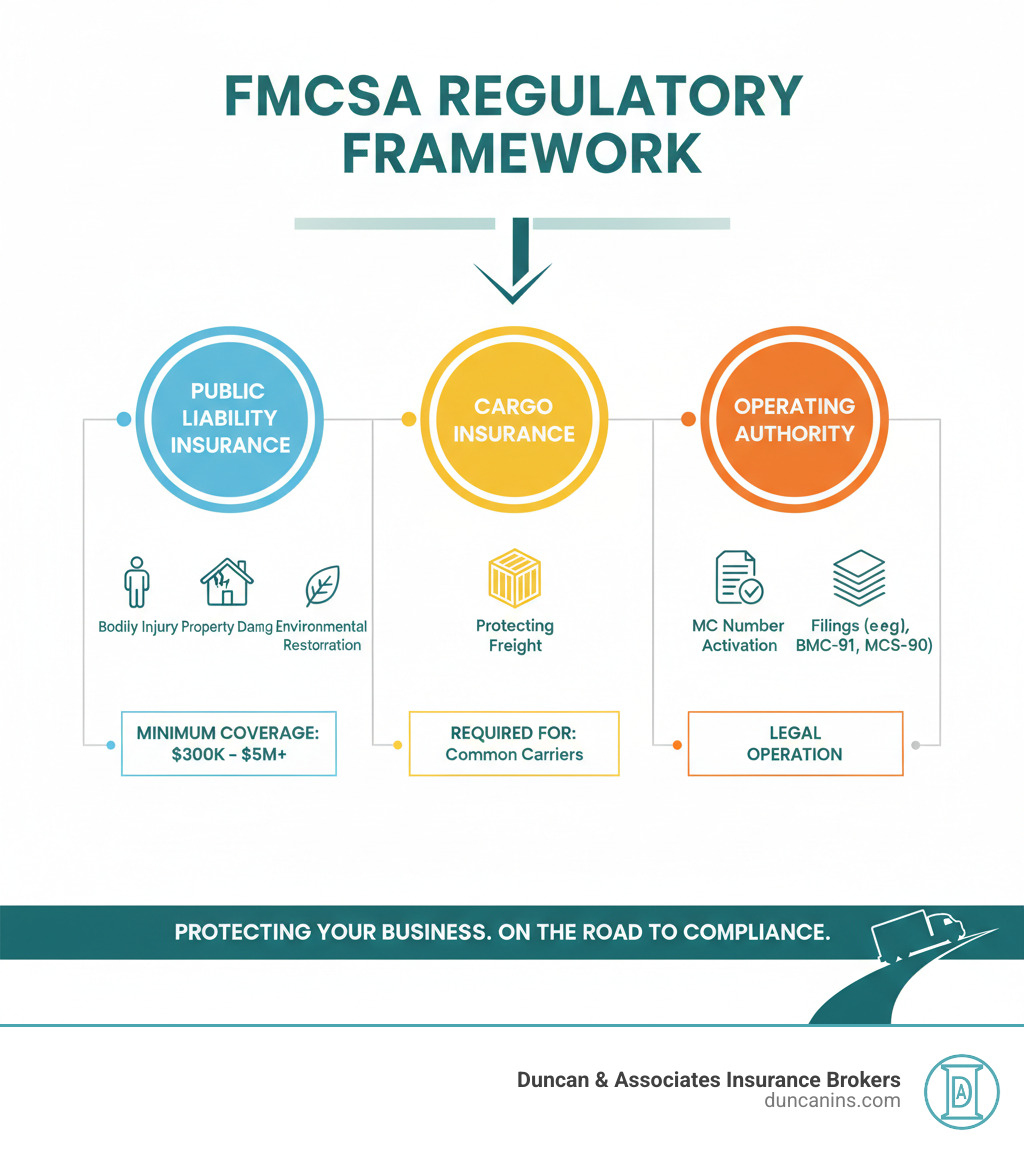
Quick look at FMCSA insurance requirements:
Understanding the Core FMCSA Insurance Requirements
The Federal Motor Carrier Safety Administration (FMCSA) requires public liability insurance for all commercial trucking and passenger transport operations. This isn’t a suggestion; it’s a mandate designed to protect the public. Public liability insurance ensures funds are available to cover bodily injury, property damage, and environmental cleanup after an accident.
These minimum financial responsibility levels are detailed in Federal Motor Carrier Safety Regulation Section 387. For-hire motor carriers transporting goods or people across state lines must meet these federal insurance obligations to activate their operating authority (MC number). Without it, you can’t legally operate. Insurance is your ticket to operate and a critical safety net. For more on basic policies, see our guide on Minimum Truck Insurance Policies Explained.
| Vehicle/Cargo Type | Minimum Liability Limit |
|---|---|
| Non-hazardous freight (vehicles under 10,001 lbs GVWR) | $300,000 |
| Non-hazardous freight (vehicles 10,001+ lbs GVWR) | $750,000 |
| Vehicles hauling motor vehicles or large equipment | $1,000,000 |
| Oil and similar substances (vehicles 10,001+ lbs GVWR) | $1,000,000 |
| Hazardous materials (vehicles 10,001+ lbs GVWR) | $5,000,000 |
| Passenger vehicles (15 or fewer passengers) | $1,500,000 |
| Passenger vehicles (16 or more passengers) | $5,000,000 |
Liability Insurance Minimums for Property Carriers
Your required liability coverage depends on your vehicle’s Gross Vehicle Weight Rating (GVWR) and the type of cargo you haul.

- Under 10,001 lbs GVWR (non-hazardous): The minimum is $300,000, covering lighter vehicles like cargo vans.
- Over 10,001 lbs GVWR (non-hazardous): The minimum increases to $750,000. This applies to most tractor-trailers, box trucks, and hot shots.
- Auto Haulers: Transporting vehicles or large equipment requires $1,000,000 due to the higher risk of damage.
- Oil and Similar Substances: Even if not classified as hazardous, hauling oil requires $1,000,000 to cover potential environmental cleanup costs.
- Hazardous Cargo: Transporting materials like flammable liquids or toxic chemicals requires $5,000,000 in coverage, reflecting the catastrophic risk.
These are legal minimums. They may not fully protect your business in a major accident. Many brokers and shippers also require higher limits. We advise clients to secure coverage that matches their actual risk, not just the federal floor.
Cargo Insurance vs. Liability Insurance
It’s crucial to understand the difference between liability and cargo insurance.
- Liability Insurance: Protects the public from you. It covers injuries to others and damage to their property if your truck causes an accident.
- Cargo Insurance: Protects the freight you’re hauling. It compensates the shipper if goods are damaged, stolen, or lost.
The FMCSA’s minimum cargo insurance is $5,000 per vehicle and $10,000 per occurrence. However, these limits are often insufficient for high-value loads. Most shippers and brokers require coverage matching the freight’s actual value. We help carriers find cargo insurance that offers real protection, not just paper compliance. Learn more in our article on Cargo Insurance Protecting Washington’s Business Interests.
What are the specific FMCSA insurance requirements for passenger-carrying vehicles?
Transporting people involves higher insurance thresholds due to increased risk.
- 15 Passengers or Fewer: The minimum liability coverage for interstate for-hire transport is $1,500,000. This applies to operations like shuttle vans and small tour buses.
- 16 or More Passengers: The minimum jumps to $5,000,000 to reflect the greater potential for casualties in an accident.
Certain operations are exempt, including taxicabs (fewer than 7 passengers, not on regular routes) and some single daily round-trip commuting arrangements (fewer than 16 people). Misclassifying your operation can lead to severe penalties. For more details, the FMCSA offers an Overview of Federal Requirements – Interstate 9 to 15 Passenger Vehicles.
The Paperwork Trail: Filings, Forms, and Endorsements
Having the right policy isn’t enough to meet FMCSA insurance requirements; you must also prove it to the federal government through official “insurance filings.” These are formal notifications your insurance company submits directly to the FMCSA, confirming you have the required coverage.

Today, this process is mostly electronic via the FMCSA’s online portal and e-Filer accounts. For technical details, see the FMCSA’s Insurance Filing Requirements.
As a motor carrier, you don’t handle these filings yourself—your insurance company does. However, understanding the forms helps you ensure everything is in order and avoid operational shutdowns.
The BMC-91 and BMC-91X Forms Explained
The BMC-91 and BMC-91X forms are how your insurer proves to the FMCSA that you have the required liability coverage.
- BMC-91: The standard form, filed by a single insurance company, certifying your policy meets federal minimums for bodily injury and property damage.
- BMC-91X: Used in more complex situations where your liability coverage is split among multiple insurers.
These are non-cancelable filings, meaning your insurer must give the FMCSA 30 days’ notice before canceling your policy. This safeguard prevents carriers from operating without insurance and gives the FMCSA time to act. Without a valid BMC-91 or BMC-91X on file, your MC number will be inactive, and you cannot legally operate in interstate commerce. Your insurance agent handles this filing, but it’s wise to confirm it has been completed.
Understanding the MCS-90 Endorsement
The MCS-90 endorsement is not a filing but a mandatory part of your commercial auto liability policy. It guarantees that your insurance will cover public liability claims up to the federal minimum, regardless of any exclusions in your policy. This endorsement ensures accident victims are compensated.
For interstate for-hire carriers, the MCS-90 is non-negotiable. Without it, your policy fails to meet FMCSA insurance requirements. It acts as a financial guarantee to the public. While the BMC-91 is a filing that proves you have a policy, the MCS-90 is an endorsement that ensures the policy provides the required public protection. Your insurer attaches this to your policy and should provide you with a copy. For official details, see the FMCSA’s MCS-90 Information Page on the FMCSA website.
Getting Started: Insurance for New Ventures and MC Activation
Starting a new trucking company involves critical regulatory steps, especially meeting FMCSA insurance requirements. Activating your Motor Carrier (MC) number and operating authority hinges on proving you have the necessary insurance. Without an active MC number, you cannot legally operate in interstate commerce, and activation requires proper insurance filings.
How do I meet the FMCSA insurance requirements to activate my MC number?
Activating your MC number requires careful timing. After applying for operating authority via the FMCSA’s Unified Registration System, your application is published, starting a 20-day filing window. Within this period, your insurer must file proof of coverage (a BMC-91 or BMC-91X form) with the FMCSA. Missing this window can lead to your application’s dismissal.
We recommend securing insurance before applying for your MC number. An experienced agent, like us at Duncan & Associates, can ensure you have the correct coverage and the mandatory MCS-90 endorsement. Your insurance company then handles the filing.
After the FMCSA processes the filing, your MC number should become active in one to five business days. We guide our clients through this waiting period, helping them monitor their status. Maintaining your authority also requires biennial updates to your FMCSA registration. For a full walkthrough, see our guide: FMCSA Insurance Requirements Explained.
Checking Your Status with the FMCSA
You can verify your filing status using the FMCSA’s free online tools.
- The SAFER Company Snapshot provides a quick overview of your company’s registration and safety data. Access it at Check your company status on the SAFER website.
- The Licensing and Insurance (L&I) public page shows the specific status of your MC number and insurance filings (active, pending, or inactive). It updates daily.
If your status is not “active” when it should be, contact your insurance broker immediately. Regularly checking these tools, especially early on, can help you catch filing errors before they lead to a suspended authority. An inactive authority means no loads and no revenue, as brokers and shippers will not work with you.
Staying Compliant: Penalties and Portal Updates
Meeting FMCSA insurance requirements isn’t something you check off once and forget about. It’s an ongoing responsibility, and the consequences for letting your coverage lapse can be severe. The agency also regularly updates its systems, so staying informed is crucial.

Consequences of Non-Compliance
Letting your insurance lapse or filings become outdated has immediate and severe consequences. Your MC number becomes inactive, legally prohibiting you from operating in interstate commerce and preventing you from booking loads.
Penalties for non-compliance include:
- Significant civil fines for operating without proper insurance.
- Out-of-service orders that ground your vehicles and drivers.
- Revocation of your operating authority, which can shut down your business.
- Full legal liability for accident damages, potentially leading to bankruptcy.
Furthermore, non-compliance negatively affects your CSA scores, leading to higher insurance premiums. Learn more about CSA Score Implications for Washington Insurance Premiums. Maintaining continuous, compliant coverage is essential for your operation.
New FMCSA Portal and Login.gov Requirements
The FMCSA is modernizing its electronic filing system. Starting in December 2024, it will require Login.gov accounts with multi-factor authentication (MFA) for all insurance filers. Traditional usernames and passwords for e-Filer accounts will be phased out.
This change primarily affects insurance companies, financial institutions, and other entities that file directly with the FMCSA. They must create new FMCSA Portal accounts linked to Login.gov to continue submitting filings.
For most motor carriers, this transition will be handled by your insurance provider. However, being aware of this change is important, as any filing delays from your insurer could impact your operating authority. We are monitoring these updates to ensure a seamless process for our clients. You can Learn more about Login.gov to understand the system.
Insurance Rules for Brokers, Forwarders, and Special Carriers
FMCSA insurance requirements also apply to freight brokers, freight forwarders, and carriers with unique operations like self-insurance or cross-border hauling.
Requirements for Brokers and Freight Forwarders
Freight brokers and forwarders, while not typically operating trucks, have their own FMCSA financial responsibility requirements.
- Freight Brokers: Must maintain a BMC-84 Surety Bond or a BMC-85 Trust Fund of at least $75,000. This guarantees payment to carriers and shippers, ensuring contractual obligations are met.
- Freight Forwarders: Often assume more responsibility for cargo. If they operate vehicles, they must meet the same public liability requirements as motor carriers, in addition to holding a bond or trust fund.
The key distinction is that brokers arrange transport, while forwarders often assume responsibility for it, impacting their insurance needs.
Self-Insurance, Waivers, and Mexican Carriers
The FMCSA allows for some special insurance arrangements, though they are uncommon.
- Self-Insurance: This is a rare option available only to large, financially stable companies that can prove they can cover claims from $750,000 to $5,000,000. The application process is rigorous, making traditional insurance more practical for most.
- Waivers/Exemptions: These are granted only in very specific and unusual circumstances and require a formal application.
- Mexican Motor Carriers: Carriers from Mexico operating beyond U.S. commercial zones must file an OP-1(MX) application and obtain US-domiciled insurance from a company licensed in the U.S. This ensures claims are handled under U.S. jurisdiction. Cross-border hauling has unique complexities, which we discuss in our guide on Key Insurance Considerations for Cross Border Hauls.
Conclusion
Navigating FMCSA insurance requirements can be complex, but compliance is the backbone of a safe and legal commercial transportation business. It’s not just about avoiding penalties; it’s about keeping your MC number active, your trucks moving, and your business protected.
A critical point to remember is the difference between minimum coverage and adequate protection. While federal minimums ($750,000 for most property carriers) keep you compliant, a single serious accident can easily surpass these limits, exposing your business to financial ruin.
At Duncan & Associates Insurance Brokers, we specialize in helping commercial carriers manage these challenges. We understand the regulations and, more importantly, we understand your business. We find coverage that truly protects your unique operation, not just one that meets the bare minimum.
Our approach is to make insurance easy and 100% hassle-free. We handle the complexities—from BMC-91 filings and MCS-90 endorsements to monitoring regulatory changes—so you can focus on running your business.
Whether you’re a new venture activating an MC number or an established fleet seeking better coverage, we’re here to help. Don’t let regulatory complexity slow you down. Let’s work together to secure the right coverage and keep your business moving forward with confidence.
