
Why Moving Company Insurance Matters: Protecting Your Business and Your Customers
Moving company insurance is essential protection covering liability for property damage, cargo in transit, commercial vehicles, and workers’ compensation. Federal regulations require interstate movers to offer Full Value Protection and Released Value Protection, highlighting the high stakes involved in transporting household goods.
For a moving and storage business, insurance is not only about checking a box for compliance. It is about protecting your balance sheet from a single accident, protecting your reputation when something goes wrong, and giving customers confidence that their household goods are in responsible hands. Moves involve tight deadlines, heavy lifting, stairs, narrow driveways, apartment elevators, and unpredictable road conditions, so even a well-run operation can face losses.
Here are a few common scenarios where the right coverage makes a measurable difference:
- Property damage at pickup or delivery: Scratched hardwood floors, broken banisters, damaged drywall, or a cracked stone countertop can turn into a costly claim quickly.
- Injuries to non-employees: A customer trips over a dolly or moving blanket, or a bystander is injured while a truck is backing up.
- Loss or damage to goods: Items can be damaged by impact, shifting loads, water exposure, smoke, fire, or theft.
- Auto accidents: A minor fender-bender can create expensive liability, plus downtime if a truck is out of service.
- Employee injuries: Strains and sprains are common, but serious injuries can occur, especially with stairs and heavy, awkward items.
Key Coverage Types:
- Commercial General Liability – Third-party injury and property damage.
- Cargo/Motor Truck Cargo Insurance – Protection for customer belongings.
- Commercial Auto Insurance – Fleet vehicle coverage.
- Workers’ Compensation – Employee injury protection.
- Commercial Property – Facility and warehouse coverage.
- Professional Liability (E&O) – Service failures.
- Cyber Liability – Data breach protection.
It is also important to separate mover liability (what the contract says you owe the customer) from insurance (a policy that can help pay covered losses). Without proper insurance, a mover might only owe $0.60 per pound for damaged items under basic Released Value Protection, leaving both the customer and the business financially vulnerable. Homeowners insurance rarely covers items handled by professional movers, making specialized business policies critical.
As Heidi Duncan, owner of Duncan & Associates Insurance Brokers, I help transportation businesses steer the complex landscape of Moving company insurance. Our team builds practical, custom solutions based on your operations, your fleet, and the types of moves you handle, so coverage matches real-world risk instead of a one-size-fits-all template.
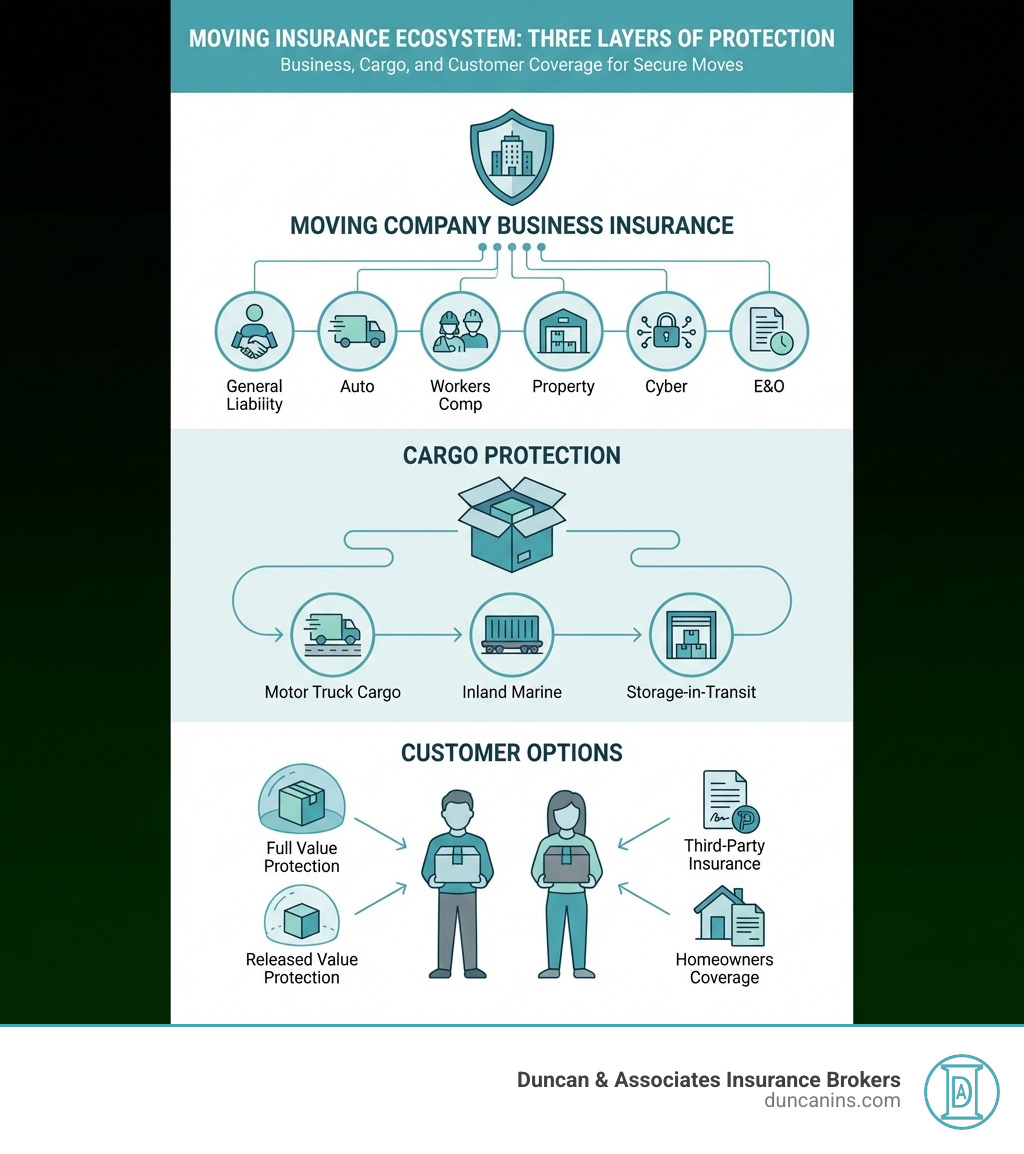
Common Moving company insurance vocab:
Core Coverage: Essential Moving Company Insurance Policies
Moving company insurance is a specialized form of Business Insurance designed for the moving and storage industry. It protects your assets, employees, and reputation from mishaps during a move.
Because moving companies often operate at customer homes, on public roads, and in temporary storage environments, coverage should be built to address multiple exposures at the same time: premises liability, auto liability, goods in your care, employee injuries, and damage to your own property. The goal is to avoid gaps between policies (for example, when an item is being moved from a house to a truck, from a truck into storage, and back out again).
Commercial General Liability Insurance
General Liability Insurance shields your business from third-party claims of bodily injury or property damage. If a crew member damages a customer’s home or a client slips in your office, CGL covers legal defense and settlements. For more details, see The Contractors Safety Net: Understanding Commercial Liability.

Practical examples of CGL-type claims in the moving world include:
- A hand truck catches a door frame and cracks the trim.
- A crew accidentally damages an elevator wall in a high-rise.
- A customer is injured walking through an entryway where moving pads are staged.
Commercial Auto Insurance
Commercial Auto Insurance for Contractors is non-negotiable. It covers damages to your vehicles, driver injuries, and liability for accidents. Fleet policies are often more cost-effective for companies with five or more trucks.

When designing an auto program, movers commonly consider how vehicles are used (local vs. long-haul), where trucks are garaged, driver experience, and whether employees take vehicles home. Safety practices like driver training, vehicle inspections, and dash cameras can also support long-term insurability.
Workers’ Compensation Insurance
Workers’ Compensation Insurance provides medical benefits and wage replacement for employees injured on the job. Given the physical nature of moving, this coverage is both a legal requirement and a moral obligation.
Workers’ comp is especially important for moving crews because injuries can happen even in routine situations, including:
- Lifting injuries from heavy furniture or appliances.
- Slips on wet walkways, icy steps, or loading ramps.
- Pinch-point injuries while maneuvering items through tight spaces.
Protecting Goods with Cargo and Moving Company Insurance
Liability insurance covers third parties, while Cargo insurance specifically covers customer belongings in your care. Cargo Insurance, or Motor Truck Cargo, protects against perils like collision, fire, and theft. For more on insuring belongings, refer to the FMCSA on insuring belongings.
Cargo coverage is often the policy that customers assume you have, but limits, deductibles, and exclusions matter. Movers should pay close attention to:
- Coverage territory: Local and intrastate moves, interstate routes, and any cross-docking or multi-stop deliveries.
- Types of property moved: Household goods vs. commercial equipment, specialty items, or high-value pieces.
- Storage exposure: Short-term warehousing, storage-in-transit, or third-party storage relationships.
Inland Marine Insurance protects mobile property, such as specialized equipment or high-value items in temporary storage, filling gaps where standard property policies fall short.
Specialized Insurance for Modern Risks
- Professional Liability (E&O): Errors and Omissions Liability Insurance protects against claims of negligence or service errors.
- Cyber Liability: Cyber Liability Insurance is vital for protecting sensitive customer data from breaches.
- Commercial Property: Commercial Property Insurance covers your office, warehouse, and equipment. Many small businesses bundle this with liability in a Business Owners Insurance (BOP) policy.
These coverages can be particularly relevant as moving companies add online estimates, digital inventory systems, electronic payments, and customer portals. If you store customer information (even something as simple as addresses and phone numbers), cyber risk becomes a real operational consideration, not just an IT problem.
Understanding Liability Levels: FVP vs. Released Value
Federal regulations require interstate movers to offer two liability options. These are contractual limits on the mover’s liability, not traditional insurance.
Full Value Protection (FVP)
Under FVP, the mover is liable for the replacement value of lost or damaged items. They may repair, replace, or pay the market value. FVP is more comprehensive but usually involves an additional charge and deductible. Items of “extraordinary value” (over $100 per pound) must be declared in writing to be covered.
Released Value Protection (RVP)
RVP is the most economical option, often free, but provides minimal protection: only $0.60 per pound per article. For example, a $1,000 antique table weighing 100 lbs would only be covered for $60.
| Feature | Full Value Protection (FVP) | Released Value Protection (RVP) |
|---|---|---|
| Cost | Additional charge | No additional charge |
| Coverage | Replacement value | $0.60 per pound |
| Default | Yes, if no other chosen | No, must be signed |
| Peace of Mind | High | Low |
For more, see the FMCSA guide on mover liability options.
Common Exclusions:
- Hazardous materials and perishables.
- Packed by Owner (PBO) boxes (unless external damage is visible).
- Undeclared high-value items.
The Role of Homeowners and Renter’s Insurance
Home insurance limitations often exclude damage caused by professional movers. While these policies cover theft or fire, they rarely cover breakage during handling. Customers may need Valuable Items coverage for high-end goods, but even these require specific endorsements for transit.
Navigating Regulations and Business Operations
FMCSA Requirements: Interstate vs. Intrastate
The FMCSA regulates interstate movers, requiring specific insurance and USDOT registration. Intrastate movers follow state-specific rules, which vary. Duncan & Associates helps movers nationwide comply with these diverse requirements.
Moving Brokers vs. Actual Moving Companies
A moving broker vs. carrier distinction is vital. Brokers book moves but don’t own trucks or carry cargo insurance. Carriers physically transport goods and must carry the primary Moving company insurance.
Business Interruption Insurance
Business Interruption Insurance helps replace lost income and cover expenses if your business closes temporarily due to a covered peril like fire. It is essential for business continuity.
Factors Influencing Cost
- Location and Fleet Size: Number and value of trucks.
- Payroll: Affects workers’ comp premiums.
- Services: Specialized moves (pianos, art) increase risk.
- Claims History: A clean record lowers premiums.
Surety Bonds
Surety Bonds may be required by states to guarantee that a moving company fulfills its contractual obligations and adheres to local regulations.
Claims and Risk Management
Customer Steps for Damage or Loss
- Inspect Immediately: Check items upon delivery.
- Document: Take photos of damage and boxes.
- Note on Bill of Lading: Record issues before the movers leave.
- File a Claim: You have nine months to file a written claim.
- Arbitration: Use arbitration programs for disputes.
Contract Considerations
Customers should ensure contracts clearly state liability options, claims procedures, and the mover’s USDOT number. Movers should work with brokers who understand industry risks and provide comprehensive support.
Understanding local rules is also key. Our guide on Understanding State Requirements for Contractors Insurance highlights the importance of compliance for movers and other contractors.
Frequently Asked Questions
What is the difference between liability and cargo insurance?
Liability insurance protects the company from third-party injury or property damage claims. Cargo insurance specifically protects the customer’s belongings while in transit or storage.
Does insurance cover items I pack myself?
Usually, movers are not liable for “Packed by Owner” (PBO) boxes unless the exterior of the box shows clear damage caused by the mover’s negligence.
How do I verify if a moving company is insured?
- Request a COI: Ask for a Certificate of Insurance.
- Check USDOT: Verify interstate movers via the FMCSA online tool.
- Ask Questions: Reputable companies are transparent about their coverage.
Conclusion
Moving company insurance is the backbone of a successful moving business. At Duncan & Associates Insurance Brokers, we make insurance hassle-free, providing expert service and custom packages to protect your fleet, employees, and customers.
Don’t settle for inadequate coverage. Contact us today for a personalized quote and build a robust safety net for your business.
