
Why Commercial Truck Fleet Insurance Is Critical for Your Business
Commercial truck fleet insurance is a specialized policy protecting businesses with multiple commercial vehicles under one comprehensive plan. Here’s a quick overview:
- What it covers: Liability for bodily injury and property damage, physical damage to your trucks, cargo protection, and uninsured motorist coverage.
- Who needs it: For-hire trucking companies, private carriers, construction firms, delivery services, and owner-operators with multiple trucks.
- How many vehicles qualify: Typically 2-5 trucks minimum, depending on the insurer.
- Key benefit: More cost-effective than insuring each vehicle separately, with simplified management and consistent coverage.
- Federal requirement: FMCSA mandates liability coverage from $300,000 to $5,000,000 based on truck weight and cargo type.
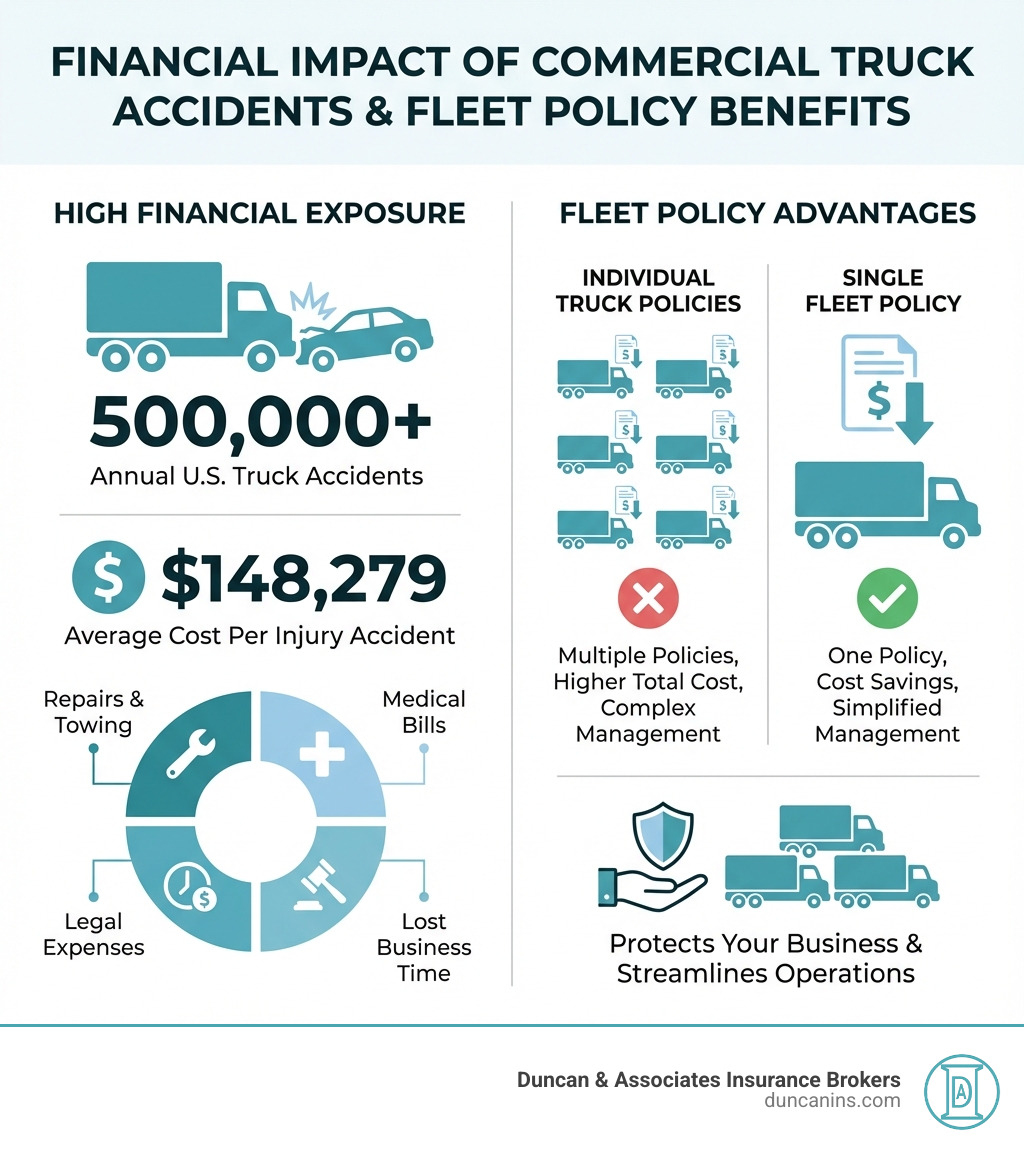
Any company with commercial vehicles faces significant financial risk. In 2021, there were over 500,000 large truck accidents in the U.S. A single injury accident costs an average of $148,279, not including repairs or legal fees. For businesses with multiple trucks, these risks multiply quickly.
Fleet insurance protects your business from these financial threats. Instead of juggling separate policies, a fleet policy bundles everything into one manageable plan, often at a lower total cost. It covers your trucks, cargo, liability to others, and damage from uninsured drivers.
As Heidi Duncan, owner of Duncan & Associates Insurance Brokers, I’ve spent years helping businesses steer the complexities of commercial truck fleet insurance. My team works with multiple carriers to find coverage that fits your unique operations, breaking down complicated policies into clear, practical guidance.
Learn more about commercial truck fleet insurance:
What Is Fleet Insurance and Why Is It Essential?
Managing insurance for each vehicle in a commercial fleet can be an administrative nightmare. Commercial truck fleet insurance offers a streamlined, economical solution by covering multiple vehicles under a single policy.
Instead of separate policies for each truck, van, or car, a fleet policy bundles them together. This simplifies management, ensures consistent coverage, and often results in lower rates than individual policies. The cost savings are a major draw, especially for fleets with three or more vehicles, though some insurers offer benefits for as few as two. A consolidated approach means less paperwork, fewer renewal dates, and a single point of contact for claims and adjustments.
Fleet insurance is ideal for any business using multiple vehicles, including taxi services, delivery companies, construction firms, and large trucking enterprises. The coverage is flexible and can include a mix of vehicle types, such as pickup trucks, tow trucks, dump trucks, tractor-trailers, and box trucks, all under one plan. Our expertise in trucking insurance ensures we can meet the unique demands of your fleet.

Who Needs Fleet Insurance?
If your operations involve more than a single commercial vehicle, you should be considering a fleet policy. Here’s a closer look at who benefits most:
- For-Hire Motor Carriers: Companies that transport goods for others and require comprehensive coverage for their vehicles, drivers, and cargo.
- Private Carriers: Businesses using their own trucks to transport their own goods, such as a construction company moving equipment or a distributor delivering products.
- Owner-Operators with Multiple Trucks: Individuals who own and operate several vehicles can benefit from the consolidated coverage and savings of a fleet policy.
- Construction Companies: Firms with diverse fleets of dump trucks, cement mixers, and flatbeds need specialized protection. Our commercial auto insurance for contractors addresses the needs of this sector.
- Delivery Services: Local and regional companies transporting parcels, food, or other goods rely on their fleet of vans and smaller trucks.
- Other Businesses: Any enterprise with multiple commercial vehicles, including utility companies, landscapers, or car rental agencies.
If your business relies on multiple vehicles, fleet insurance is a strategic necessity.
Key Benefits of a Single Fleet Policy
Opting for a single commercial truck fleet insurance policy brings several advantages to support your business’s financial health and operational efficiency.
- Reduced Premiums: Insurers often offer discounts for bundling multiple vehicles, making fleet insurance more affordable than individual policies.
- Administrative Ease: A single policy means one renewal date and one premium, simplifying management and reducing paperwork.
- Consistent Coverage: All vehicles and drivers are covered under the same terms, eliminating potential gaps from managing separate policies.
- Flexibility to Add/Remove Vehicles: Easily add or remove vehicles as your business changes, with prorated premiums ensuring you only pay for what you need.
- Any-Driver Coverage Provisions: Many policies cover any authorized employee, which is practical for businesses where drivers operate different vehicles.
Navigating the Costs and Coverages of Commercial Truck Fleet Insurance
Understanding commercial truck fleet insurance means getting the right policy customized to your business. A well-constructed fleet policy is a vital tool for managing risk.
Policy components include various coverages that mitigate financial losses from accidents, damage, or liability claims. Since a one-size-fits-all approach rarely works, we help you balance comprehensive protection with your budget to get the most value. For a foundational understanding of requirements, see our guide on minimum truck insurance policies explained.

What Key Coverages Are Included in a Commercial Truck Fleet Insurance Policy?
A robust commercial truck fleet insurance policy is built upon several foundational coverages to protect your business from a wide range of risks:
- Primary Liability: Legally mandated for most trucking operations, this is the cornerstone of your policy.
- Bodily Injury Liability: Pays for medical expenses and lost wages for anyone injured in an accident where your driver is at fault.
- Property Damage Liability: Covers damage to another person’s property, like their vehicle or building, if your truck causes an accident.
- Physical Damage: Protects your own fleet vehicles from damage, regardless of fault, to get them back on the road quickly. It includes:
- Collision Truck Insurance: Covers repair or replacement costs if your truck collides with an object or overturns.
- Comprehensive Coverage: Protects against non-collision incidents like theft, vandalism, fire, or hitting an animal. Learn more in our article on comprehensive vs. collision coverage: what truckers need.
- Motor Truck Cargo: Critical for carriers, this protects the cargo you are hauling against loss or damage from perils like collision, fire, or theft.
- Uninsured/Underinsured Motorist (UM/UIM): Protects your business if your driver is in an accident with an at-fault driver who has little or no insurance.
What Factors Influence the Cost of Commercial Truck Fleet Insurance?
The cost of commercial truck fleet insurance is a dynamic calculation based on factors unique to your operation. Understanding these variables is key to managing your premiums:
- Vehicle Type and Age: Newer, more expensive, or specialized trucks (e.g., reefers, dump trucks) generally cost more to insure due to higher repair costs.
- Operating Radius: Local fleets typically have lower premiums than regional or long-haul operations because longer distances increase accident exposure.
- Cargo Hauled: Transporting hazardous materials or high-value goods leads to higher premiums than general freight due to increased risk.
- Driver Records: Clean motor vehicle records (MVRs) for all drivers can lead to lower premiums, while a history of violations will increase costs.
- Claims History (Loss Runs): A history of frequent or high-cost claims indicates higher risk and leads to increased rates.
- CSA Score Implications for Washington Insurance Premiums: Your Carrier Safety Administration (CSA) score reflects your safety compliance and heavily influences rates nationwide. A poor score signals higher risk.
- Deductible Amount: Choosing a higher deductible (the amount you pay out-of-pocket) can lower your premium.
- Coverage Limits: Higher liability limits offer more protection but result in higher costs. Federal and state regulations dictate minimums, which can range from $300,000 to $5,000,000.
Important Additional Coverages to Consider
While core coverages form your policy’s foundation, specialized operations often call for additional protections to fill potential gaps:
- Non-Trucking Liability (NTL): Provides liability protection for owner-operators leased to a motor carrier when using their truck for personal, non-business purposes. Learn more about non-trucking liability insurance requirements.
- Bobtail Insurance Coverage: Covers a tractor when it’s driven without a trailer attached, whether under dispatch or not.
- Trailer Interchange: Provides physical damage protection for non-owned trailers your fleet hauls under a written interchange agreement.
- Refrigeration Breakdown: A must-have for reefer fleets, this covers perishable cargo loss due to mechanical failure of the refrigeration unit.
- General Liability Insurance: Protects your business from non-auto-related incidents, such as slips and falls on your premises.
- Commercial Umbrella Insurance: Offers an extra layer of liability protection above the limits of your primary policies, protecting against catastrophic claims.
Meeting Legal Requirements and Getting a Quote
Operating a commercial truck fleet requires navigating complex legal and regulatory requirements. Compliance with federal and state mandates is non-negotiable, as failure can lead to fines and shutdowns. Your commercial truck fleet insurance policy is a critical document proving you adhere to the law. We stay current on developments, like insights on truck insurance laws after 2025 changes, to keep you compliant.
Federal and State Insurance Filings
Insurance filings are official documents submitted to regulatory bodies to prove your vehicles have the required insurance coverage.
- FMCSA Requirements: The Federal Motor Carrier Safety Administration (FMCSA) requires most interstate trucking businesses to file proof of financial responsibility, typically through liability insurance. Review USDOT compliance for details.
- MCS-90 Endorsement: This key federal endorsement guarantees that minimum liability limits will be paid to third parties after an accident, ensuring the public is protected.
- State-Specific Filings: Each state may have its own insurance requirements and filing procedures, which can include higher liability limits for intrastate operations.
- Minimum Liability Limits: Federal regulations mandate minimum liability coverage based on cargo type and vehicle weight, ranging from $750,000 for general freight to $5,000,000 for hazardous materials.
Navigating these filings can be daunting, but our team is here to ensure your commercial truck fleet insurance policy meets all legal benchmarks.
How to Get a Quote for Your Fleet
Securing the right commercial truck fleet insurance begins with an accurate quote. As independent brokers, we make this process easy by shopping with multiple carriers for you. To provide competitive quotes, we’ll need some key information:
- Vehicle Details: VIN, make, model, year, and mileage for each truck.
- Driver Records: Motor Vehicle Records (MVRs) for all drivers.
- Business Information: Operating history, cargo type, operating radius, and safety programs.
- Loss Run Reports: Your claims history from the last three to five years.
- USDOT Number and Authority: For interstate carriers.
Working with an Independent Agent: As independent brokers, Duncan & Associates does the legwork for you. We work with a network of top-rated carriers to compare quotes and find the best coverage for your fleet and budget. Our client-first service simplifies the process and provides expert guidance. To start, visit our insurance quote page.
How Fleet Insurance Manages Risk and Protects Your Business
Commercial truck fleet insurance is a proactive risk management tool that protects your business from the constant risks of commercial trucking.
Fleet insurance provides financial mitigation, helping cover the substantial costs of an accident, which can average $148,279 for a single injury. It offers crucial asset protection for your trucks and cargo against damage, theft, or loss. A single major incident without coverage could be financially devastating.
Beyond assets, fleet insurance safeguards your brand reputation. An efficient claims process demonstrates responsibility and helps maintain client trust. We offer risk control and claims services to minimize incidents and streamline resolution. For guidance, review our best practices for filing a trucking insurance claim in Washington.
Choosing the Right Insurance Partner
Selecting the right partner for your commercial truck fleet insurance is as crucial as the policy itself. Their capabilities directly impact your business’s resilience.
- Financial Strength: Prioritize insurers with strong financial ratings from firms like A.M. Best, which demonstrate the stability to pay large claims. You can check an insurer’s A.M. Best rating to verify their stability.
- Claims Handling Reputation: A partner’s ability to process claims efficiently and fairly is paramount to minimizing downtime. We work with carriers known for excellent claims services.
- Risk Management Resources: The best partners provide resources to help prevent claims, such as safety programs, driver training, and telematics insights.
- Customer Service: A dedicated broker like Duncan & Associates acts as your advocate, simplifying the insurance experience with personalized service from knowledgeable professionals.
Proactive Risk Management Strategies
While commercial truck fleet insurance provides a critical safety net, proactive strategies are essential for reducing incidents and lowering your insurance costs.
- Driver Safety Programs: Invest in comprehensive driver training, review MVRs regularly, and incentivize safe driving to foster a safety culture. Our insights on important Washington truck driver safety measures to cut costs offer advice applicable nationwide.
- Vehicle Maintenance Schedules: A well-maintained fleet is safer. Implement strict preventative maintenance schedules and conduct routine inspections to prevent accidents from mechanical failures.
- Telematics and Monitoring: Use telematics systems to monitor driver behavior, track vehicles, and identify risky habits. This data can help with coaching and may lead to lower premiums.
- General Safety Practices: Enforce compliance with safety regulations and reward safe drivers. These practices, combined with your insurance, create a comprehensive shield for your business. For more tips, see our guide to discover tips for lowering your truck insurance.
Frequently Asked Questions about Commercial Truck Fleet Insurance
Here are some of the most frequent inquiries about commercial truck fleet insurance and our expert answers.
How many trucks do I need to qualify for fleet insurance?
The definition of a “fleet” varies by insurer. Some require five or more vehicles, but others allow fleet policies for as few as two. It’s often most cost-effective when you have at least three vehicles, as the savings and administrative benefits become more significant.
Does fleet insurance cover personal use of a truck?
Standard commercial truck fleet insurance is for business use and may not cover personal activities. However, endorsements like Non-Trucking Liability (NTL) can be added. NTL provides liability protection when a leased owner-operator uses their truck for personal, non-business purposes. Learn more about non-trucking liability insurance requirements. We can customize your policy to include this if needed.
Can I add or remove trucks from my policy mid-term?
Yes. A key advantage of commercial truck fleet insurance is its flexibility. You can easily add or remove vehicles mid-term. Premiums are prorated, so your coverage always reflects your current fleet size without needing to rewrite the policy.
Conclusion
Navigating commercial truck fleet insurance is critical for any business with multiple vehicles. A comprehensive policy, including core and specialized coverages, is your shield against road risks. Understanding cost factors, legal requirements, and proactive risk management can protect your assets and lower your premiums.
Investing in robust commercial truck fleet insurance is a smart business move that protects your assets, financial stability, and brand reputation. With the right coverage, you can focus on keeping your business moving forward, prepared for the unexpected.
As an independent agency, Duncan & Associates Insurance Brokers offers choice and expert, client-first service. We understand every fleet is unique and leverage our nationwide reach to make insurance easy and hassle-free. Our team simplifies complex policies to find the perfect commercial truck fleet insurance solution for your operations and budget.
Don’t let insurance complexities slow you down. Contact us for your comprehensive trucking insurance needs today, and let us help you protect what you’ve built.
