
Why Understanding Annuities Matters for Your Retirement
Buying an annuity can feel overwhelming. With thousands of products on the market, it’s hard to know where to start. Here’s what you need to know:
Quick Answer: The 5 Steps to Buying an Annuity
- Assess your financial goals – Determine your retirement income needs and risk tolerance
- Research providers – Check financial strength ratings and customer reviews
- Select the right annuity type – Choose between fixed, variable, indexed, or immediate annuities
- Fund your annuity – Use a lump sum, multiple payments, or roll over retirement accounts
- Review and sign – Understand all fees, terms, and your free-look period
Nearly two in three Americans worry more about outliving their retirement savings than death itself. An annuity is designed to solve this problem. It’s a contract with an insurance company where you pay a premium, and in return, you receive guaranteed income payments for a set period or for life.
But annuities are complex, and only 19% of Americans can correctly define them. Hidden fees and steep penalties can make choosing the wrong one a costly mistake.
That’s why having a trusted guide matters. I’m Heidi Duncan, owner of Duncan & Associates Insurance Brokers. For years, I’ve helped clients steer the complexities of buying an annuity, cutting through the jargon to find solutions that match their retirement goals.
This guide will walk you through everything you need to know before you invest, from understanding the types of annuities to evaluating providers and deciding if one is right for you.
Understanding Annuities: The Foundation of Guaranteed Income
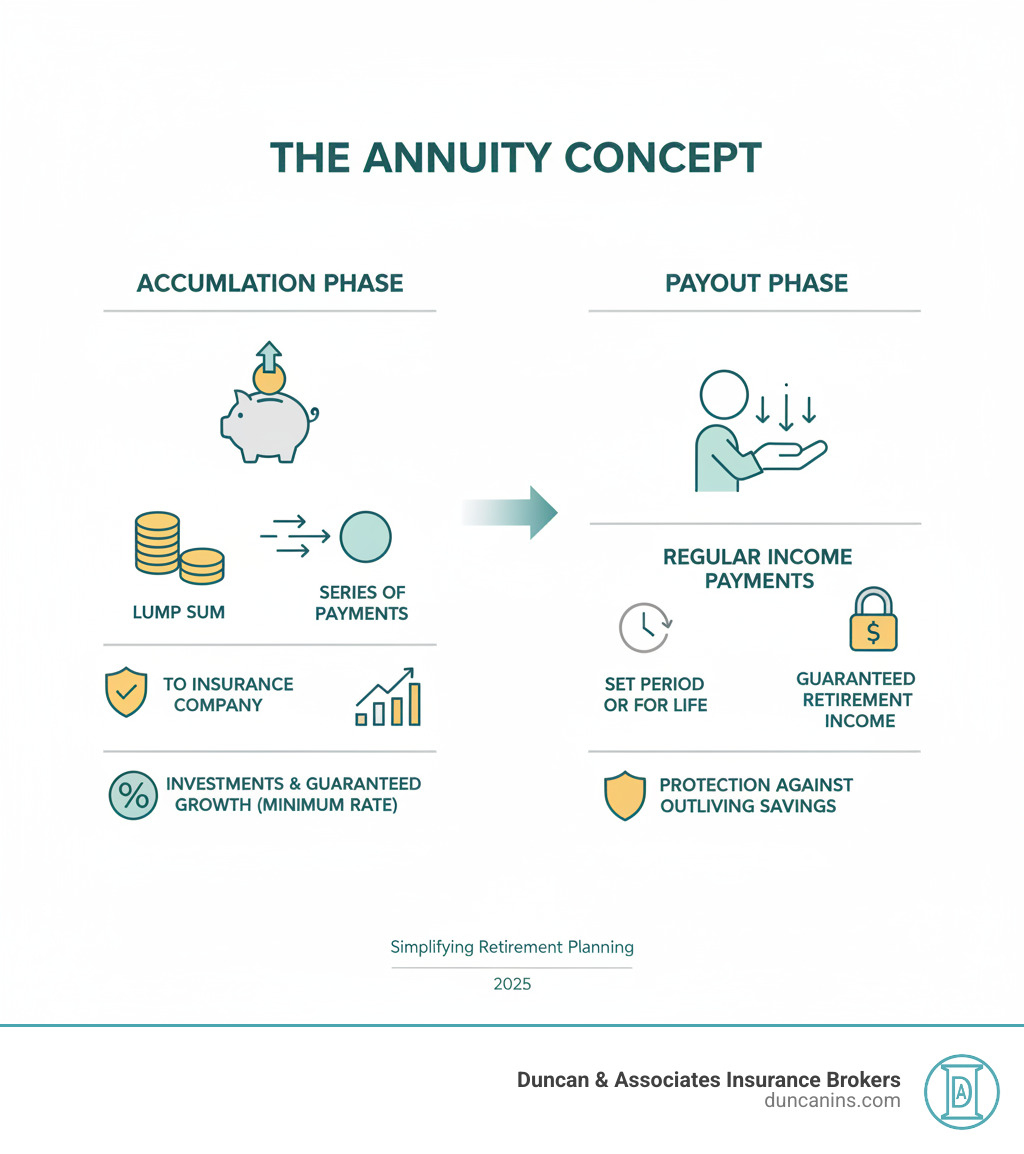
An annuity is a contract with an insurance company: you pay them now, and they promise to pay you a steady income later, potentially for life. When buying an annuity, you’re purchasing a guarantee that you won’t outlive your money in retirement.
During the accumulation phase, you fund the annuity with a lump sum or multiple payments. Your money grows tax-deferred, meaning you don’t pay taxes on earnings until you withdraw them.
The payout phase (or annuitization) begins when the insurer starts sending you regular income payments. These payments can last for a set number of years or your entire lifetime, with terms locked in per your contract.

Annuities are for long-term retirement planning, not short-term goals or emergencies. If you need quick access to your funds, an annuity is likely not the right fit.
Want to explore more? Check out more info about annuities or dive into the detailed resources from Investor.gov on annuities.
The Main Types of Annuities
When you’re buying an annuity, you’ll find different types that offer trade-offs between growth, risk, and predictability. Let’s break down the main options.
A fixed annuity is the simplest option. It offers a guaranteed minimum interest rate and predictable, steady income payments. Your principal is protected, making it a low-risk choice for those who value security.
With a variable annuity, your money is invested in sub-accounts similar to mutual funds. Returns and income payments fluctuate with market performance. You have higher growth potential but also risk losing principal, suiting investors comfortable with market risk.
An indexed annuity (FIA) links returns to a market index like the S&P 500. It has a cap on gains and a floor (often 0%) to protect your principal from losses, offering a balance of growth potential and safety.
A Registered Index-Linked Annuity (RILA) offers more growth potential than an FIA but with only partial downside protection, often a “buffer” that absorbs an initial portion of losses. It’s a middle ground between indexed and variable annuities.
Timing also matters. An immediate annuity starts payments within a year, ideal for current income needs. A deferred annuity delays payments, allowing your money more time for tax-deferred growth.
Here’s how these stack up:
| Annuity Type | Growth Potential | Risk Level | Income Stream Predictability |
|---|---|---|---|
| Fixed Annuity | Moderate (guaranteed rate) | Low (insurer guarantee) | High (fixed payments) |
| Variable Annuity | High (market-dependent) | High (market risk) | Variable (market-dependent) |
| Indexed Annuity (FIA) | Moderate (index-linked, capped) | Low (principal protected) | Moderate (index-linked, capped) |
| RILA | Moderate to High (index-linked, buffered) | Moderate (partial market risk) | Moderate (index-linked, buffered) |
| Immediate Annuity | N/A (payments start immediately) | Low (insurer guarantee) | High (fixed payments) |
| Deferred Annuity | Varies by underlying type (Fixed, Variable, Indexed) | Varies by underlying type | High (once annuitized) |
How Annuity Payments Work
When you’re ready for income, you’ll choose a payout structure. This decision affects your payment amount and what happens to any remaining money when you die.
A lifetime income (or single life) option provides guaranteed payments for as long as you live. Payments stop upon death, with nothing going to heirs.
A life with period certain option provides lifetime income but also guarantees payments for a minimum period (e.g., 10 or 20 years). If you die before this period ends, a beneficiary receives the remaining payments.
The joint and survivor option continues payments as long as you or your partner is alive. The survivor can receive the full payment or a reduced amount (e.g., 50%), ensuring financial security for a spouse.
A fixed period income option provides payments for a set number of years. It’s useful for bridging an income gap or funding a specific short-term goal.
Systematic withdrawals offer flexibility to take regular distributions, but the income is not guaranteed for life.
A lump-sum payment is sometimes an option, but it often triggers surrender charges and taxes and is generally not the intended use of an annuity.

Which payout option is right for you depends on your marital status, health, and legacy goals. There’s no universal right answer–just the right one for your situation.
A Step-by-Step Guide to Buying an Annuity
Buying an annuity is a significant financial decision. Approaching it systematically makes the process manageable.
For a comprehensive walkthrough, you can reference this helpful resource: Buying an Annuity: A step-by-step guide. But let’s walk through it together.
Step 1: Assess Your Financial Goals and Needs
Before looking at products, understand your financial picture.
First, create a realistic retirement budget, including both essential and discretionary spending. Underestimating expenses is a common mistake.
Then, calculate your guaranteed income from sources like Social Security and pensions. The difference between your expenses and this income is the gap an annuity can help fill.
Finally, assess your risk tolerance (your comfort with market swings) and your risk capacity (your financial ability to handle a downturn). Your capacity for risk often decreases as you near retirement.
If you’re looking to round out your retirement planning, you might find it helpful to explore More info about Individual Retirement Accounts.
Step 2: Research and Choose a Reputable Provider
An annuity is a long-term contract, so the insurance company’s financial stability is critical.
Check financial strength ratings from agencies like A.M. Best and Moody’s. Look for companies rated A+ or higher to ensure they can meet their long-term obligations. Also, research customer service records through online reviews and complaint ratios.
A licensed agent is invaluable for navigating these complex products. They can translate jargon and help you compare options.
There’s a difference between agent types. A captive agent represents one company, while an independent agent–like us at Duncan & Associates–works with multiple carriers. This allows us to shop the market for you, comparing products and prices to find the best fit for your needs.

Step 3: Select the Right Annuity and Complete the Application
Now it’s time to choose your annuity.
Your agent will help you with product comparison. Whether a fixed, variable, or indexed annuity is right for you depends on your goals and risk tolerance.
Consider optional riders to customize your annuity. Common options include cost-of-living adjustments, death benefits for heirs, or long-term care benefits. These add-ons come at a cost but can be valuable.
Perform a thorough contract review with your agent. Understand all details–payouts, fees, surrender charges, and guarantees–before signing.
The application process involves providing personal and financial information for a suitability review, which is required by law to protect consumers.
Use the free-look period (typically 10-30 days) after receiving your contract. During this time, you can cancel for a full refund for any reason.
Step 4: Fund Your Annuity
The last step in buying an annuity is funding it. You have several options.
A lump-sum payment is a single, large contribution, often from savings, an inheritance, or the sale of a business.
You can also fund an annuity with multiple premiums over time, either on a flexible or scheduled basis.
You can rollover funds from eligible retirement accounts like an IRA or 401(k) into an annuity tax-free. This is a popular way to convert a nest egg into guaranteed income.
A 1035 exchange allows you to transfer funds from an existing life insurance policy or annuity into a new annuity without a taxable event. This can be useful for moving to a better product, but be aware that a new surrender period will begin.
For those with substantial assets, annuities can play a strategic role in a comprehensive wealth protection plan. You can learn more about how annuities fit into broader financial strategies at More info about High Net Worth Insurance.
The Financial Details: Costs, Payouts, and Taxes
When buying an annuity, understand the costs, payouts, and taxes. With annuity sales on the rise, a clear understanding of the financial mechanics is more important than ever.

Factors That Determine Your Annuity Income
Your annuity income is calculated based on several factors:
- Premium Amount: The more you invest, the higher your income.
- Age and Gender: Older individuals receive higher payments. Because women have a longer life expectancy, they may receive slightly lower monthly payments than men of the same age.
- Life Expectancy: Insurers use actuarial tables to estimate your lifespan. In some cases, health issues can result in higher payments.
- Interest Rates: Higher interest rates at the time of purchase generally lead to higher income payments.
- Annuity Type: Your choice of a fixed, variable, or indexed annuity will fundamentally affect your income stream.
- Payout Options: A single-life payout will be higher than a joint and survivor option. Adding beneficiary guarantees will also adjust the payment amount.
Common Fees and Charges Associated with Annuities
Understanding the fee structure is crucial. Common fees include:
- Commissions: These are paid to the agent and are built into the product’s price, not charged as a separate fee.
- Surrender Charges: Penalties for withdrawing money during the surrender period (often 3-10 years). These charges decrease over time.
- Administrative Fees: Flat or percentage-based fees for contract maintenance.
- Mortality & Expense (M&E) Fees: Found in variable annuities, these cover the insurer’s guarantees and are charged as a percentage of the contract value.
- Rider Costs: Additional fees for optional benefits like inflation protection or improved death benefits.
- Market Value Adjustment (MVA): In some fixed annuities, this can adjust your surrender value based on interest rate changes if you withdraw early.
How Annuity Income is Taxed
Annuities offer tax-deferred growth, meaning your earnings compound without being taxed annually. You pay taxes only upon withdrawal.
If funded with qualified (pre-tax) money like from a 401(k), all distributions are taxed as ordinary income.
If funded with non-qualified (after-tax) money, only the earnings portion of distributions is taxed. Your principal is returned tax-free via an exclusion ratio.
Withdrawals before age 59 1/2 are typically subject to a 10% early withdrawal penalty from the IRS, in addition to ordinary income tax.
Advanced Life Deferred Annuities (ALDAs) are specialized products that defer payments until late in life (e.g., age 85) to protect against outliving savings. They have unique tax rules. More info about the tax rules for advanced life deferred annuities.
Consult a tax professional before buying an annuity, as tax implications are complex and depend on your personal situation.
Weighing the Pros, Cons, and Protections
Buying an annuity involves trade-offs. It’s important to understand the benefits, drawbacks, and protections in place.
Benefits of Buying an Annuity
- Guaranteed Lifetime Income: The core benefit is an income stream you cannot outlive, providing peace of mind and acting like a personal pension.
- Market Protection: Fixed and indexed annuities protect your principal from market downturns, offering stability for your retirement savings.
- Tax-Deferred Growth: Your money grows without being taxed annually, allowing for more efficient compounding until you make withdrawals.
- Death Benefits: Many annuities ensure that if you die before payments begin, your beneficiaries receive the remaining value. More info about Individual Life Insurance.
- Customization: Payouts can be custom to your needs (single, joint, etc.) and can fill gaps between your expenses and other income sources like Social Security.
- Creditor Protection: In many states, annuity assets are shielded from lawsuits and creditors.
Drawbacks and Risks to Consider
- Illiquidity: Your money is locked up for a set term. Early withdrawals trigger surrender charges, making annuities unsuitable for emergency funds.
- Fees: Costs can be high, especially on variable annuities. Understand all fees (commissions, administrative, M&E, riders) to ensure they are justified.
- Complexity: Annuity contracts can be complex. Working with a trusted agent is key to understanding the fine print.
- Inflation Risk: Fixed payments may lose purchasing power over time due to inflation. Cost-of-living riders can help but come at a cost.
- Lower Returns: The trade-off for safety is often lower potential returns compared to direct market investments.
- Insurer Risk: Guarantees are backed by the insurance company. If it fails, you could have a problem, though protections exist.
How Your Annuity is Protected
Multiple layers of protection exist to safeguard your retirement income.
- State Guaranty Associations: Every state has an association to protect policyholders if an insurer fails, typically covering up to $250,000-$500,000 per person.
- Financial Strength Ratings: Choose insurers with high ratings from agencies like A.M. Best, which assess a company’s ability to pay claims long-term.
- Regulatory Oversight: Insurers are required by state regulators to maintain sufficient financial reserves to cover their obligations.
- Not FDIC Insured: Annuities are insurance products, not bank accounts, so they are not insured by the FDIC. Protection comes from the insurer and state guaranty associations.
For Canadian clients, Assuris provides similar protection for annuity income. Find the list of insurance companies that are members of Assuris.
Is an Annuity Right for You? Timing and Alternatives
The decision of if and when to buy an annuity depends on your unique situation. Let’s explore when buying an annuity makes sense and how it fits into a retirement income strategy.
When is the Best Time for Buying an Annuity?
Certain life situations often point to annuities as a smart choice:
- Nearing Retirement: As you shift from accumulating wealth to creating income, the appeal of a guaranteed income stream grows.
- Maxed Out Other Accounts: If you’ve maxed out your 401(k) and IRA contributions, an annuity offers another vehicle for tax-deferred savings.
- Seeking Income Stability: If you are risk-averse and prefer a predictable, stable income stream over market volatility, an annuity can provide peace of mind.
- Conservative Investor Profile: If you value principal protection and guaranteed returns over aggressive growth, the “slow and steady” nature of annuities may be a good fit.
- Concerned About Outliving Savings: With increasing lifespans, “longevity risk” is a major concern. A lifetime annuity transfers this risk to the insurance company, guaranteeing you won’t outlive your income.
Annuities and Other Retirement Income Options
Annuities are a powerful tool, but they work best as part of a diversified retirement strategy that includes multiple insurance-based solutions.
Systematic Withdrawal Plans: Many annuities allow you to take regular withdrawals without fully annuitizing, offering income with more flexibility and control over your principal.
Life Insurance with Cash Value: Permanent life insurance policies build cash value that can be accessed tax-advantaged in retirement, serving as a supplemental income source. More info about Individual Life Insurance.
Long-Term Care (LTC) Riders: Available on some annuities and life insurance policies, LTC riders can help cover healthcare costs in retirement, protecting your other assets.
Diversification is Key: A robust plan might use an annuity for essential expenses, cash value life insurance for discretionary spending and legacy goals, and an LTC rider for healthcare protection. This layered approach creates a comprehensive safety net. More info about Term Life Insurance.
The goal is to create a well-rounded retirement income plan that aligns with your specific needs, risk tolerance, and financial goals. At Duncan & Associates, we specialize in helping you find the right combination of insurance-based solutions that work for you.
Frequently Asked Questions about Buying an Annuity
Here are answers to the most common questions we hear about buying an annuity.
Can I lose all my money in an annuity?
It’s highly unlikely, but it depends on the annuity type.
With fixed and indexed annuities, your principal is protected from market losses by the insurance company.
With variable annuities, your value is tied to market performance, so you can lose principal. This is the trade-off for higher growth potential.
If the insurance company fails, state guaranty associations provide a safety net, typically protecting contract values up to $250,000-$500,000 per person, depending on the state.
The best defense is to choose a financially strong insurer with high ratings from agencies like A.M. Best.
How much of my retirement savings should I put into an annuity?
There is no universal answer, as the right amount depends on your personal financial situation.
A common strategy is to use an annuity to cover the gap between your essential living expenses and your other guaranteed income sources, like Social Security or a pension.
Many financial professionals suggest allocating 25% to 50% of retirement savings to guaranteed income products, leaving the rest for growth-oriented investments. The right percentage for you depends on your specific needs and risk tolerance.
Can I change my mind after buying an annuity?
Yes. Every annuity includes a free-look period, typically 10 to 30 days, during which you can cancel the contract for a full refund for any reason.
This is your safety net, so use this time to review the contract and ask questions to ensure you are confident in your decision.
After the free-look period ends, you are committed. Withdrawing early will likely incur significant surrender charges, as annuities are long-term products. These charges decrease over time but can be substantial in the early years of the contract.
This is why we spend so much time upfront helping clients understand exactly what they’re signing up for. Buying an annuity shouldn’t feel rushed. It’s a significant decision that deserves careful thought.
Conclusion
Buying an annuity is a commitment to your future peace of mind. This guide has covered the types of annuities, the buying process, the costs and benefits, and the protections in place for your investment.
Retirement planning shouldn’t be a hassle. At Duncan & Associates Insurance Brokers, our goal is to make insurance easy. We take the time to understand your needs, explain your options clearly, and compare products from top-rated companies to find the right fit for your goals.
Having a trusted partner makes all the difference. We’re here to help you build a financial strategy that brings you confidence and security for the years ahead.
The conversation about your retirement doesn’t have to wait. If you’re curious about how an annuity might complement your overall financial plan, or if you’re ready to explore your options, we’d love to hear from you. Get a quote for your Individual Life Insurance needs or reach out for a personalized consultation. Let’s work together to create the worry-free retirement you’ve been working toward your entire life.
